
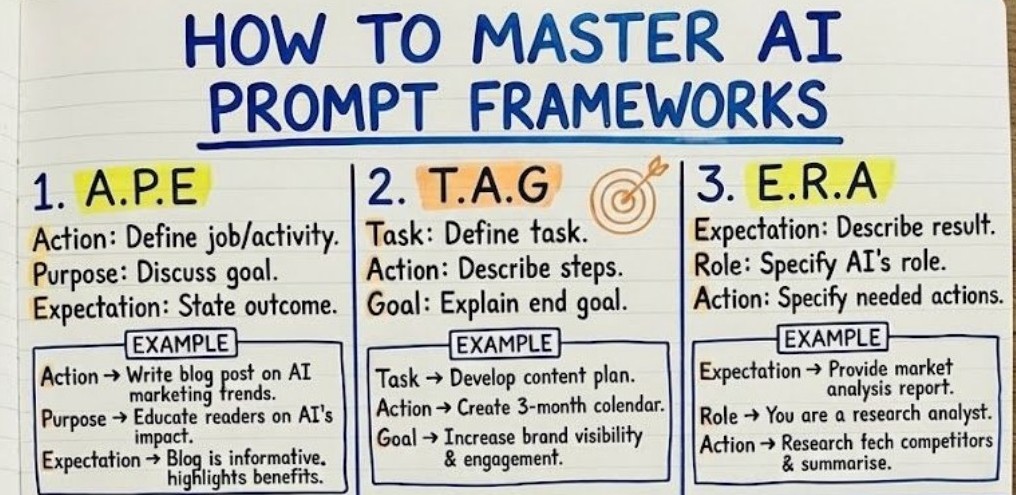
Most people treat AI like a search engine, but it’s actually more like a junior employee—it needs clear instructions and a sense of “who” it is supposed to be. These 8 AI prompt engineering frameworks solve the “blank page” problem for the model. Instead of the AI guessing your tone or intent, you’re giving it a structural map.
If you’re serious about using AI for actual work, pick one or two of these and stick to them. It’s the fastest way to get consistent results without the constant back-and-forth.
1. A.P.E (Action, Purpose, Expectation)
- Action: Define the job or activity.
- Purpose: Describe why you’re doing it.
- Expectation: State exactly what a “good” output looks like.
Use when: You know what you want done, but the quality bar is unclear.
Prompt For 8 Professional Frameworks
Action: Define the job or activity.
Purpose: Describe why you’re doing it.
Expectation: State exactly what a “good” output looks like.
2. T.A.G (Task, Action, Goal)
- Task: Define the core task in one line.
- Action: List the key steps AI should take.
- Goal: Explain the final result you’re aiming for.
Use when: You want AI to “think in steps” instead of guessing.
Prompt For 8 Professional Frameworks
Task: Define the core task in one line.
Action: List the key steps AI should take.
Goal: Explain the final result you’re aiming for.
3. E.R.A (Expectation, Role, Action)
- Expectation: Describe the desired result in detail.
- Role: Tell AI who it should act as.
- Action: Specify what it must do to get there.
Use when: Tone, persona, or expertise really matter.
Prompt
Expectation: Describe the desired result in detail.
Role: Tell AI who it should act as.
Action: Specify what it must do to get there.
4. R.A.C.E (Role, Action, Context, Expectation)
- Role: Specify AI’s role (expert, strategist, teacher, etc.).
- Action: Detail the main action you need.
- Context: Give background, constraints, and examples.
- Expectation: Define success and failure clearly.
Use when: You want fewer rewrites and tighter first drafts.
Prompt
Role: Specify AI’s role (expert, strategist, teacher, etc.).
Action: Detail the main action you need.
Context: Give background, constraints, and examples.
Expectation: Define success and failure clearly.
5. C.A.R.E (Context, Action, Result, Example)
- Context: Set the stage with who/what/why.
- Action: Describe the task in simple language.
- Result: Explain the outcome you want.
- Example: Share a sample to mirror or avoid.
Use when: You have a “reference” you like (or hate).
Prompt For 8 Professional Frameworks
Context: Set the stage with who/what/why.
Action: Describe the task in simple language.
Result: Explain the outcome you want.
Example: Share a sample to mirror or avoid.
6. C.O.A.S.T (Context, Objective, Actions, Steps, Task)
- Context: Explain the situation.
- Objective: Clarify the main goal.
- Actions: Tell AI what it should do first.
- Steps: Ask for step-by-step reasoning or plan.
- Task: Define the final deliverable.
Use when: You want both a plan and an output.
Prompt
Context: Explain the situation.
Objective: Clarify the main goal.
Actions: Tell AI what it should do first.
Steps: Ask for step-by-step reasoning or plan.
Task: Define the final deliverable.
7. T.R.A.C.E (Task, Role, Action, Context, Expectation)
- Task: Define the main task.
- Role: Describe the expertise required.
- Action: State exactly what to do.
- Context: Add audience, channel, and constraints.
- Expectation: Clarify format, length, and style.
Use when: You’re delegating something important to AI.
Prompt
Task: Define the main task.
Role: Describe the expertise required.
Action: State exactly what to do.
Context: Add audience, channel, and constraints.
Expectation: Clarify format, length, and style.
8. R.O.S.E.S (Role, Objective, Steps, Solution, Scenario)
- Role: Define who AI is acting as.
- Objective: State the single, clear goal.
- Steps: Outline the situation and key steps.
- Expected Solution: Describe the ideal answer.
- Scenario: Ask how to reach that solution in your case.
Use when: You want AI to diagnose + solve your specific scenario.
Prompt
Role: Define who AI is acting as.
Objective: State the single, clear goal.
Steps: Outline the situation and key steps.
Expected Solution: Describe the ideal answer.
Scenario: Ask how to reach that solution in your case.
Use this prompt to generate your version? Share in the comments or on Twitter!
Explore more? View the Writing & Content Creation category.
I hope you’ve found this Gemini Nano Banana Pro AI Prompt helpful.
Follow me @bigprompt for more.
Like/Repost if you can this prompt.
Internal link:
Miniature Brand Stores: Mastering 3D Isometric Dioramas
Cinematic Aerials: Your Guide to Airplane Window Photography
Master Luxury Hero Shots in Food Photography: Your Ultimate Guide to Stunning Visuals
Create Stunning Product Photos and Ingredient Showcases with Ingredient Orbit