
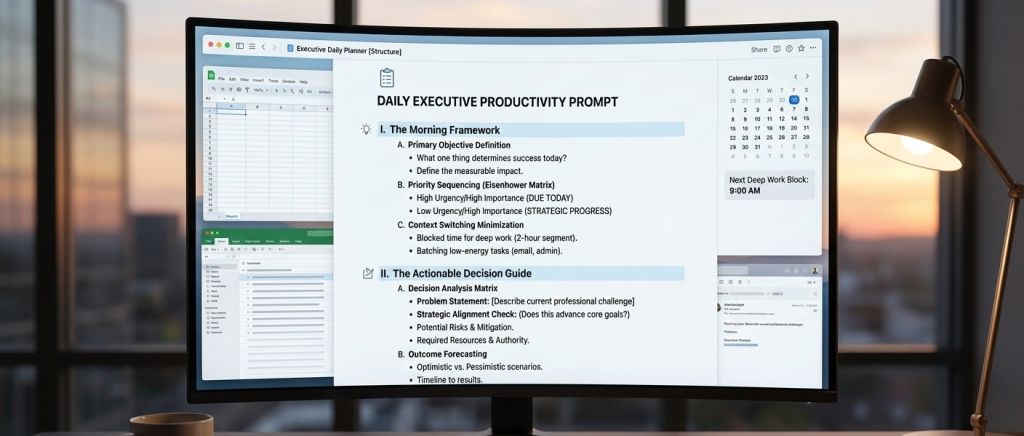
The executive productivity prompt is a specialized design framework for transforming large language models into multi-dimensional professional assistants. This system utilizes role-based anchoring and task-decomposition logic to convert vague user inputs into structured execution plans, deep insights, or optimized refinements. By integrating goal-oriented output instructions, the protocol effectively bridges the gap between complex challenges and actionable solutions. It provides a reliable method for professionals to achieve high-density information processing and superior decision-making quality across various operational domains.
Executive Productivity Prompt
Model fit: ChatGPT, Claude, Gemini, and other major LLMs.
Select the desired module below and replace the bracketed [ ] variables with specific context to execute the logic.
1. Strategic Daily Planning Prompt
Act as an executive productivity coach.

Help me organize my day using the following information:
- Goals for today: [list goals]
- Tasks: [list tasks]
- Meetings: [list meetings]
- Deadlines: [list deadlines]

Then:
1. Identify my top 3 priorities
2. Suggest a structured schedule
3. Highlight tasks that can be automated or delegated
4. Recommend the highest-impact activities for today.
2. Research Assistant Prompt
Act as a professional research analyst.
Research the following topic: [topic]

Provide:
1. Key insights
2. Current trends
3. Important statistics
4. Major companies or players involved
5. Opportunities or risks in this space.
3. Thinking Clarity Prompt
I will share a rough idea or unstructured thoughts.

Your task is to:
- Clarify the core idea
- Organize it logically
- Identify missing pieces
- Suggest improvements

Here is the idea:
[Paste your thoughts]
4. Learning Accelerator Prompt
Act as an expert teacher in [topic].
Explain this concept clearly and efficiently:
[topic]

Structure the explanation into:
- Simple explanation
- Key principles
- Real-world examples
- Common mistakes people make
- A short summary for quick recall.
5. Decision-Making Assistant Prompt
Help me evaluate the following decision:
[Describe the situation]

Analyze:
1. Pros and cons
2. Potential risks
3. Long-term implications
4. Alternative options

Then recommend the most rational course of action.
6. Writing Improver Prompt
Improve the following text to make it:
- Clearer
- More persuasive
- More concise
- More professional
- Keep the original meaning but improve the quality of the writing.

Text:
[Paste text]
7. Problem-Solving Prompt
Help me solve the following problem step by step:
[Describe the problem]

Do the following:
1. Identify the root causes
2. Break the problem into smaller parts
3. Suggest possible solutions
4. Recommend the most effective approach.
8. Business Idea Evaluation Prompt
Act as a startup advisor.
Evaluate the following business idea:
[describe idea]

Analyze:
- Market demand
- Target customers
- Competitive landscape
- Revenue potential
- Major risks

Provide an honest recommendation.
9. Information Simplifier Prompt
Simplify the following information so it is easy to understand.

Break it into:
1. Key points
2. Simple explanations
3. Practical implications

Information:
[Paste text]
10. Weekly Reflection & Improvement Prompt
Help me reflect on my week and identify improvements.

I will share:
- What went well
- What didn’t go well
- What I learned

Then help me:
- Identify patterns
- Suggest improvements
- Set better goals for next week.
How to Use
- Context Injection: Provide explicit, granular details within the brackets. The quality of the output scales directly with the density of the input variables.
- Iterative Refinement: Use these prompts as starting protocols. If an output lacks depth, isolate the weak point and apply Prompt #7 (Problem-Solving) to that specific segment.
- Sequential Stacking: Combine frameworks for complex workflows. For example, run a concept through Prompt #3 (Thinking Clarity) before feeding the structured output into Prompt #8 (Business Idea Evaluation).
Use Cases
- Corporate Strategy Implementation: Aligning daily team operations with high-level organizational objectives through the strategic planning framework.
- Rapid Market Intelligence: Extracting critical competitor data and industry trends via the professional research analysis protocol.
- Complex Risk Assessment: Evaluating high-stakes investments or operational pivots using multi-dimensional decision-making logic.
Why This Prompt Framework Works
The executive productivity prompt succeeds through intentional cognitive constraint. By establishing a rigid hierarchical structure, these prompts bypass the model’s algorithmic tendency for generic, conversational filler. The persona-driven logic anchors the AI to a professional standard of quality, while task-decomposition ensures that complex problems are addressed in manageable, logical increments. This creates a system-level reliability necessary for enterprise environments.
Common Mistakes & Fix
- Vague Variable Inputs: Supplying a one-word topic (e.g.,
[marketing]) leading to surface-level output. Fix: Expand variables into complete descriptive sentences (e.g., [B2B SaaS marketing trends in the European sector]). - Ignoring the Persona Constraint: Removing the “Act as…” directive. Fix: Always retain the persona to ensure the LLM accesses the appropriate high-level latent weights within its training data.
FAQ
- Do these work consistently across all AI models?
Yes. Because they rely on foundational logic structures rather than model-specific syntax, they function effectively across all major platforms, though reasoning models (like the GPT-4 series) will handle the analytical prompts better.
- How can I prevent the AI from hallucinating data in the research prompt?
Append a negative constraint to Prompt #2, such as: “Rely only on verified, real-world data. If specific statistics are unavailable, state that explicitly.”
Big Prompt Hub Review
The executive productivity prompt represents a critical shift from casual AI usage to standardized prompt engineering. Each module is engineered for high-signal output, bypassing common generative flaws. The consistency of these frameworks across different LLMs proves their industrial durability, providing a massive efficiency multiplier for decision-makers and knowledge workers alike.
Leave a Reply