
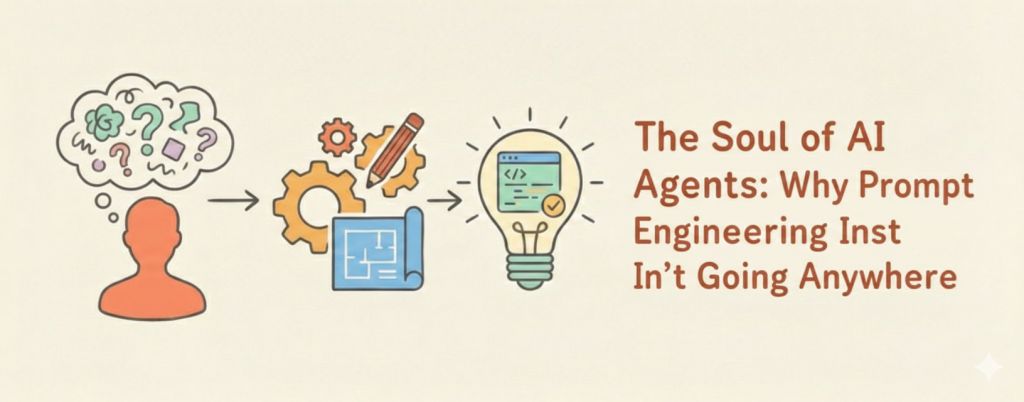
Everyone’s talking about building teams of AI agents these days.
Frameworks like Skill are taking off, and tools like OpenClaw (which some fondly call “little lobster”) make it dead simple to spin up your own agent crew.
In the middle of all this hype, a few people are already writing off prompt engineering as outdated or irrelevant.
Hold on a second.
A carefully designed prompt is basically the standard operating procedure—the SOP—for a single agent.
It spells out exactly what to do, how to think, and where the guardrails are.
Prompts and agents aren’t rivals; they complement each other.
If you want to orchestrate a full team effectively, you first need to master prompts for individual agents.
I’d even argue that a great prompt is the soul of any agent.
Without a solid soul, no matter how elaborate your multi-agent setup is, it’ll just spin its wheels without real direction.
The Real Value Is in Clear Thinking
Prompt engineering isn’t really about “talking to AI better.”
It’s about forcing yourself to think clearly—to nail down exactly what you want and how to express it.
A lot of people get stuck here, and it has nothing to do with the tech.
They simply haven’t clarified their own goals or priorities.
Until that’s sorted, throwing more agents at the problem won’t magically fix it.
How Prompting Has Evolved
Starting around Claude 3.5, my own prompting style changed.
I used to obsess over every word.
Now I just share the core idea, key details, and constraints, then let the model draft the prompt for me.
I review, tweak, and we’re good to go.
After a few rounds of this loop, the edits get smaller and smaller.
My instructions get sharper, and the model starts reading my subtext better.
It becomes a real collaboration: I figure out where my strengths end and the AI’s begin, and both sides level up together.
Why Things So Often Go Off the Rails
One harsh reality: many adults’ reading, writing, and reasoning skills peaked in high school.
Years of short videos and bite-sized feeds have dulled those abilities.
That’s why, when I train non-technical friends on AI, the most common complaint is:
“Why did it suddenly go off and do random stuff without checking if it understood what I actually wanted?”
My standard fix: always end your instructions with something like,
“Before taking any action, ask me one clarifying question to confirm you’ve understood the goal.”
One quick alignment check saves ten rounds of rework.
Multi-Agent Systems Need Strong Individual Foundations
The power of multi-agent systems comes from division of labor—splitting complex tasks across specialized roles.
But every single role still depends on its underlying prompt to perform well.
If those base prompts are vague or sloppy, the whole team suffers, no matter how clever your task routing is.
Looking Ahead
As agent frameworks mature, prompt engineering won’t fade—it will become even more central.
The people who pull ahead will be the ones treating prompts as reusable, shareable, continuously refined building blocks (stored in repos, shared in communities, iterated over time).
In short, agents are exciting, but they’re amplifiers.
They magnify whatever instructions you feed them.
Get the instructions right first, and everything else follows naturally.
Follow me @bigprompt for more.
Internal link:
Surreal Smartphone Portal Prompt – Hyper-Realistic Drink Pour Across Worlds
Custom 3D Figure “Starter Pack” Prompt
Seedance Prompt Examples for Jimeng/Dreamina Multi-Shot Video
Leave a Reply