
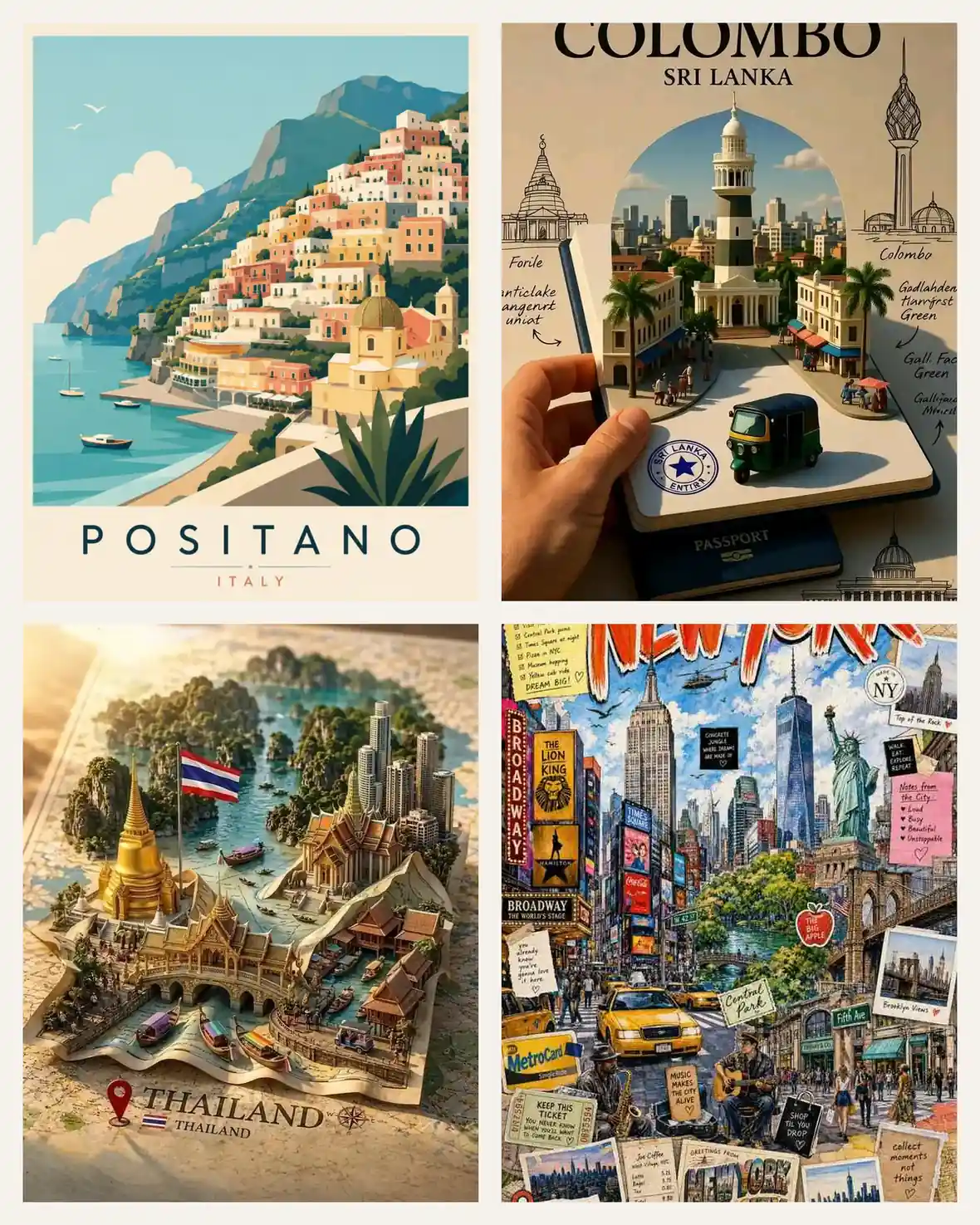
Destination designers, tourism marketers, and editorial creators choose travel poster prompts by composition first: scrapbook, passport, map, minimalist print, or editorial collage. This routing page sends each brief to the existing specialist article, so users get the right full prompt and repair guidance without mixing unrelated visual systems.
Image Example

Pack Overview
This is a plural route-selection page. Choose a visual system here, then continue to the linked page for the full working prompt, model guidance, and repair notes.
Choose the travel-poster structure before opening a specialist prompt: this page routes a brief to print, editorial collage, collectible object, diorama, painterly, or postcard logic, so the full prompt begins with the right composition.
Need one boarding-pass frame specifically? Use the singular Travel Poster Prompt with a Boarding-Pass Frame. It is the exact implementation page, not one of this hub’s five broader route choices.
Travel Poster Prompt Collection
Print & editorial starters
Prompt 1: Boarding-Pass Frame
- Target: ticket-framed destination posters.
- Input: destination, route line, travel details, landmark stack.
- Model fit: ChatGPT image generation for ticket geometry and hierarchy.
- Expected output: one print-ready poster with the pass as its frame.
- Quality check: ticket silhouette remains legible.
Create a vertical travel poster where a premium boarding pass frames [destination]. Use [route line], [travel details], and [landmarks]; keep the ticket readable and destination-led.Full version: Boarding-Pass Travel Poster Prompt.
Prompt 2: Scrapbook City Collage
- Target: layered city-memory poster art.
- Input: city, title, maps, tickets, stamps, landmarks.
- Model fit: GPT Image 2 or ChatGPT for collage control.
- Expected output: readable editorial scrapbook poster.
- Quality check: one dominant city identity.
Create a scrapbook travel poster for [city] with [city title], layered maps, tickets, stamps, notes, and [landmarks]. Keep one central city cluster and readable editorial hierarchy.Full version: Scrapbook Travel Poster Prompt.
Prompt 3: Passport City Diorama
- Target: hand-held booklet miniatures.
- Input: city, landmarks, vehicles, skyline cues.
- Model fit: ChatGPT image generation for object realism.
- Expected output: city rising from a passport booklet.
- Quality check: local details lead the scene.
Create a realistic hand holding a passport-style booklet for [city]. From its pages build a miniature street diorama with [landmarks], [vehicles], and [skyline cues].Full version: Passport City Diorama Prompt.
Prompt 4: Pop-Up Map Diorama
- Target: folded map travel worlds.
- Input: destination, landmarks, waterways, emblem.
- Model fit: GPT Image 2 or ChatGPT for paper geometry.
- Expected output: collectible map miniature.
- Quality check: map and city feel integrated.
Create a folded paper map for [destination] opening into a miniature world with [landmarks], [waterways or roads], and [emblem]; use warm tilt-shift depth.Full version: Pop-Up Map Diorama Prompt.
Prompt 5: Minimalist Destination Print
- Target: restrained vector-style prints.
- Input: destination, silhouette, palette, sky field.
- Model fit: image models that hold flat-shape discipline.
- Expected output: calm recognizable destination poster.
- Quality check: identity survives simplification.
Create a minimalist travel print for [destination] using flat vector shapes, [limited palette], a strong sky field, and [landmark silhouette]. Keep it clean, calm, and print-ready.Full version: Minimalist Travel Poster Prompt.
Prompt 6: Editorial Travel Collage
- Target: magazine-like city collages.
- Input: destination, paper textures, motifs, headline, landmarks.
- Model fit: GPT Image 2 for layered editorial composition.
- Expected output: organized city collage poster.
- Quality check: texture does not bury the place.
Create an editorial travel collage for [destination] with layered paper, [local motifs], [headline], and one central landmark cluster. Keep the density organized and the city identity coherent.Full version: Travel Collage Poster Prompt.
Collectible object & painterly starters
Prompt 7: Watercolor Architecture
- Target: cultural architecture posters.
- Input: location, interior, exhibits, regional detail.
- Model fit: image models with perspective control.
- Expected output: watercolor-and-ink destination study.
- Quality check: aligned verticals and scaled visitors.
Create a watercolor-and-ink architectural poster for [city or location] with [cultural interior], aligned perspective, [local exhibits], and respectful [regional details].Full version: Watercolor Travel Poster Prompt.
Prompt 8: Pop-Up Postcard Scene
- Target: premium postcard keepsakes.
- Input: location, landmark set, season, transport, ephemera.
- Model fit: image models for 3D paper scenes.
- Expected output: layered postcard diorama.
- Quality check: crisp paper edges and readable thumbnail.
Create a 3D pop-up postcard diorama of [destination] with [landmarks], [season or flora], [route or water], and [transport] on a textured paper postcard.Full version: Pop-Up Postcard Diorama Prompt.
Prompt 9: Paper-Cut Suitcase City
- Target: tactile suitcase-city posters.
- Input: city, country, landmarks, transport, scenery.
- Model fit: image models for paper-cut depth.
- Expected output: miniature city object.
- Quality check: verified local identity over generic buildings.
Create a paper-cut miniature city for [city], [country] with [landmarks], [local transport], and [natural scenery], arranged as a tactile suitcase travel poster.Full version: Paper Cut Travel Diorama Prompt.
Prompt 10: Watercolor City Postcard
- Target: warm city postcards.
- Input: city, aspect ratio, resolution, landmark view.
- Model fit: image models that preserve soft watercolor.
- Expected output: handmade summer postcard.
- Quality check: safe print and social margins.
Create a soft watercolor city postcard for [city] at [aspect ratio] and [resolution]. Use [landmark view], warm handmade color, and safe margins for print or social crops.Full version: Watercolor City Poster Prompt.
Prompt 11: Vintage Editorial Print
- Target: archival collectible travel prints.
- Input: city, country, landmark symbol, scenes.
- Model fit: image models for layered collage structure.
- Expected output: vintage editorial destination art.
- Quality check: the central silhouette organizes every scene.
Create a vintage editorial travel collage for [city], [country]. Use [iconic landmark] as the central silhouette, blending [architecture, streets, transport, and landscape] into one coherent destination print.Full version: Vintage Travel Collage Poster Prompt.
Companion skill: if you already have a travel photo and want sparse editorial art rather than a poster prompt, use the Travel Photo Abstraction Skill.
Strategic Deployment Guide
- Target: Destination designers, tourism marketers, and editorial creators choosing a travel-poster layout before generation.
- Input: Destination, desired visual structure, landmark family, and required level of print or editorial polish.
- Model fit: Use the linked specialist page because model guidance differs between flat minimalism, physical-object dioramas, and dense collage work.
- Expected output: One confident route choice and one relevant standalone prompt page.
- Quality check: The route should match the composition logic before decorative travel details are added.
Selection Logic
- Use scrapbook when the story comes from collected ephemera and city memory.
- Use passport or map dioramas when a physical travel object should define the scene.
- Use minimalist print when silhouette, spacing, and restraint matter more than texture.
- Use editorial collage when layered paper and local cultural motifs carry the visual voice.
Implementation Steps
- Choose the poster layout route before selecting landmarks or a color palette.
- Open the linked specialist page, copy its complete poster prompt, and replace only the destination variables that page provides.
- Generate one destination poster composition, then refine microtype and small labels in post-production instead of adding them to every prompt run.
Use Cases
- Tourism campaign deck: a destination studio selects a travel-poster system before commissioning launch assets.
- Editorial travel package: a magazine team pairs a restrained travel-poster opener with a richer collage or diorama feature.
- Souvenir poster concepting: a city-shop designer chooses map or passport routes for collectible print-poster ideas.
Why These Prompts Work
The five pages solve different layout decisions. Routing by structure prevents a destination brief from becoming a generic skyline poster and keeps the full, source-specific prompt where it belongs: on its specialist page.
Troubleshooting & Optimization
- The result feels generic: choose a stronger route before adding more landmarks.
- The scene is cluttered: reduce ephemera and preserve one dominant framing object.
- Small text fails: treat ticket fields, labels, and stamps as post-production work.
FAQ
- Q: What are travel poster prompts best used for?
A: They help a destination brief begin with the right poster structure instead of a generic tourism visual. - Q: When should I use the singular Travel Poster Prompt page?
A: Use it when the requested composition is specifically a boarding-pass frame. - Q: Which route is best for a collectible city object?
A: Start with the passport-city or pop-up-map diorama page.
Follow @bigprompt, then explore Image & Design and Prompt Engineering Guides.
Next reading for travel visual routes
Travel Poster Prompt with a Boarding-Pass Frame
Scrapbook Travel Poster Prompt
Minimalist Travel Poster Prompt guide
Big Prompt Hub Review
This Hub is useful as a choice layer, not as a substitute for the five specialist pages. Pick the composition system here, then move to the linked article for the complete prompt and deeper execution guidance.