
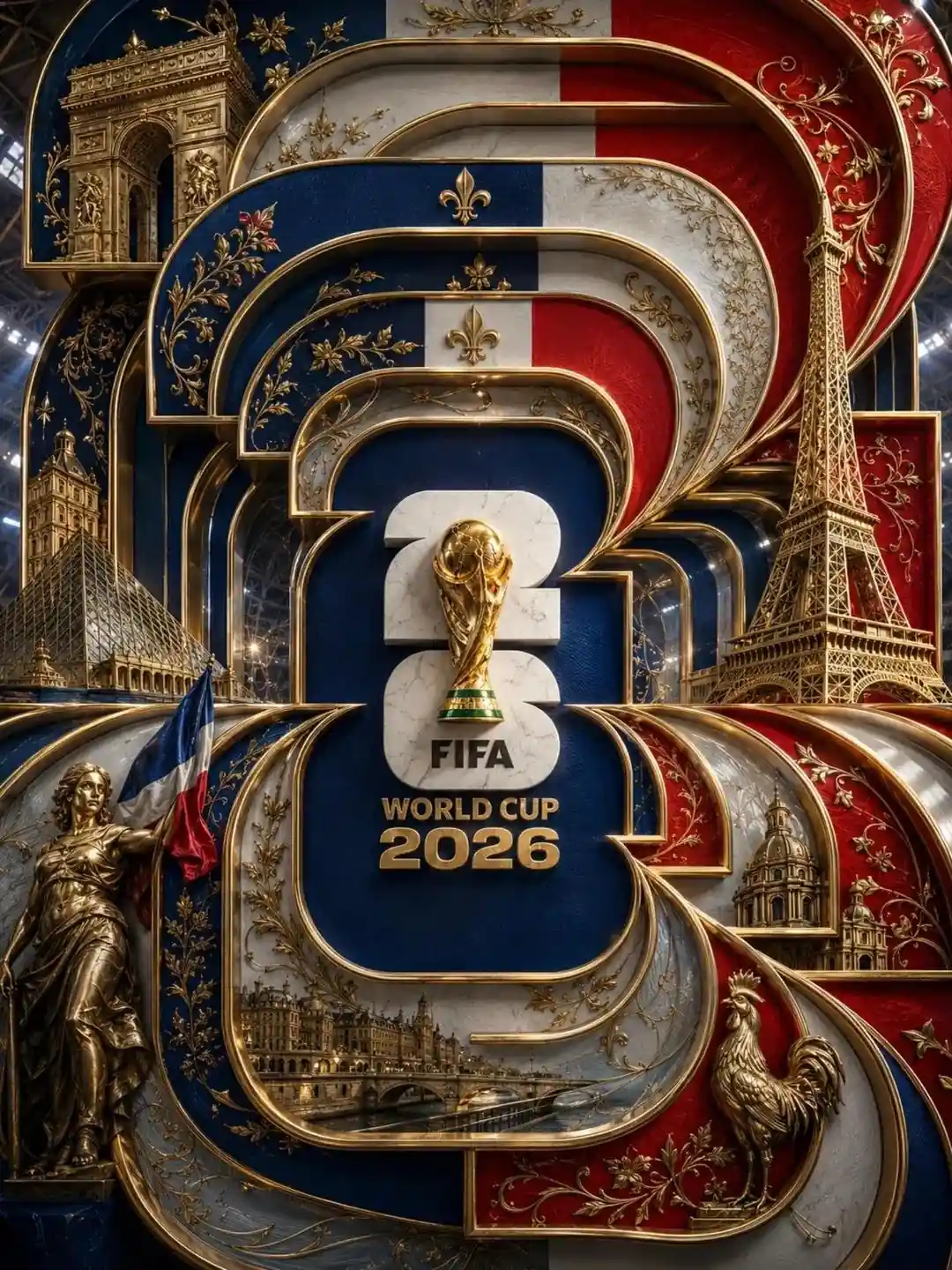
National-team campaign art stays more coherent when a World Cup country poster prompt gives sports marketers and editorial designers one frame for trophy symbolism, country identity, and luxury tournament depth without collapsing into a generic match poster. The same structure can then swap any country, rebuild the palette from the flag, and preserve metallic relief with less guesswork.
Image Example

Strategic Deployment Guide
Model fit: GPT Image 2 on ChatGPT stays closest to the source because it handles metallic relief layering, luxury typography, and dense landmark ornament with strong surface control. Keep the trophy centered, preserve one country-only symbol set per run, and treat the 2026 numerals as architectural objects rather than simple text.
World Cup Country Poster Prompt Code
CORE BRIEF:
Create an ultra-detailed luxury 3D FIFA World Cup poster for [country] in a vertical premium campaign layout. The composition should feel like a collectible tournament advertisement, built around massive layered "2026" typography and a centered World Cup trophy.

TYPOGRAPHY ARCHITECTURE:
Make the numerals "2026" dominate the poster. Build them from interlocking metallic ribbons, sculpted architectural frames, marble inlays, gilded trims, and stacked relief layers. The numbers should feel monumental, elegant, and deeply dimensional rather than flat text.

COUNTRY VISUAL SYSTEM:
Use a polished [country palette: primary, secondary, accent] derived from the national flag first. If the flag is visually sparse, borrow one ceremonial or material accent from the country's sports culture, architecture, or national crest. Add metallic trim, ornate filigree, floral or civic engravings, embossed surfaces, marble textures, and a heritage-driven luxury finish that matches [country].

IDENTITY CONTROL:
Keep [country] unmistakable through one consistent palette, one coherent landmark family, one symbol family, and one local civic-sculpture language. Do not mix references from multiple countries or continents in the same poster.

CENTRAL HERO:
Place the FIFA World Cup trophy in the center of the composition with clear hierarchy. Below or around it, include readable [campaign subtitle] space, but keep the main visual emphasis on the trophy nested inside the layered numeral architecture.

LANDMARK AND SYMBOL LAYER:
Embed recognizable [country landmarks], [country symbols], [heritage motifs], and [civic sculpture cues] throughout the poster. These elements should appear as bronze or gold relief details, sculpted inserts, or architectural extensions within the typography.

LIGHTING AND MATERIALS:
Use dramatic stadium lighting, cinematic contrast, volumetric light rays, photoreal materials, ray-traced reflections, and hyper-detailed metallic craftsmanship. Add [supporting ornamental details] only if they reinforce the chosen country's heritage direction.

SCENE LOGIC:
Build the scene in sequence: shape the outer 2026 numeral shell first, nest the landmark reliefs inside the numeral cavities second, place the trophy at the center third, and add decorative trim plus subtitle space last. This order keeps the poster readable at a glance.

COMPOSITION RULES:
Keep the composition symmetrical, layered, and highly readable. Preserve clear depth separation between the numerals, landmarks, trophy, and decorative frames. The result should feel like that country's heritage fused with premium football branding.

EXPORT GOAL:
Output one high-resolution poster suitable for tournament campaign art, sponsor mockups, editorial sports covers, premium fan merchandise, and social launch visuals.

Negative prompt: avoid flat poster graphics, cheap textures, broken numeral structure, cluttered landmarks, weak tricolor separation, muddy gold surfaces, distorted trophy proportions, unreadable text, or generic football stock-poster composition.
Why This Framework Functions
The framework works because the poster is anchored by one dominant control shape: the layered 2026 numeral structure. Once the numbers and trophy hierarchy are fixed, the chosen country’s landmarks, filigree details, and heritage symbols can stack into the composition without dissolving into a random tourism collage. That keeps the prompt reusable while staying faithful to the original premium football-poster logic.
Implementation Steps
- Build the country kit first: Fill [country], [country palette: primary, secondary, accent], [country landmarks], [country symbols], and [campaign subtitle], then generate one pass where the 2026 structure reads clearly before adding more ornament.
- Use the easy palette rule: Start with the flag’s two or three dominant colors. If that looks too thin, add one ceremonial metal or material accent from the crest, federation badge, or landmark stonework instead of inventing random hues.
- Curate the landmark composition: Use a short list of iconic local landmarks and heritage motifs, and explicitly reject mixed-country references if the poster starts drifting.
- Protect the trophy composition: If the relief work starts overpowering the center, append clear centered World Cup trophy, strong focal hierarchy, unobstructed central silhouette.
- Run a material-isolation check: Reject outputs with weak metal contrast, muddy stone textures, or flattened relief edges, then rerun with tighter material language before moving the art into campaign comps.
- Finish the production file outside the model: Rebuild subtitle text, clean any distorted badge lettering, and slightly rebalance the palette in Figma or Photoshop after export if the national colors read unevenly.
Application Scenarios
- Tournament launch art: Hero visuals for countdown campaigns, landing pages, and social unveil posts around any national World Cup narrative.
- Brand sponsorship mockups: Premium football partnership concepts for agencies pitching luxury or travel-adjacent campaign systems.
- Editorial sports covers: Magazine-style poster art for tournament previews, special reports, and national-team feature packages.
- Collector-style merchandise: Limited-run prints, fan posters, or hospitality assets that need a more ornate and prestigious visual language.
Why This Prompt Works
This prompt works because it separates hierarchy from decoration. The year numerals and trophy define the structure, while the country symbols work as controlled inserts rather than competing hero objects. That sequencing helps GPT Image 2 maintain readability, luxury depth, and national identity in the same frame instead of drifting toward either a plain sports poster or a generic travel montage.
Troubleshooting & Optimization
- The numerals look flat: Append monumental layered 2026 typography, stacked metallic depth, sculpted frames, embossed marble inlays.
- The landmarks feel chaotic: Append fewer larger country landmarks, clean hierarchy, architectural relief integration, no scattered collage elements.
- The trophy disappears: Append clear centered World Cup trophy, strong focal hierarchy, unobstructed central silhouette.
- The poster reads like tourism art instead of football branding: Append premium tournament campaign poster, stadium lighting atmosphere, high-end sports-brand launch visual.
FAQ
- Q: What makes a World Cup country poster prompt different from a generic football poster prompt?
A: This template is country-swappable by design. It keeps the layered 2026 structure and centered trophy stable, then lets you replace palette, landmarks, motifs, and symbols for China, Japan, Korea, France, Brazil, or any other national variation. - Q: How should I choose colors if I am not a designer?
A: Use a simple rule: take the two or three dominant flag colors first, then add one ceremonial accent only if the design feels too flat. Good accents usually come from a crest, medal metal, landmark stone, or federation badge. - Q: How many landmarks or symbols should I use for one country?
A: Start with three to five strong references. A shorter list of larger landmarks, one symbol family, and one sculpture language usually reads better than a dense pile of tiny objects. - Q: Should I trust the generated subtitle or campaign text?
A: Only if it renders unusually clean. For production work, it is safer to preserve the text zone inside the prompt and rebuild the final wording after export.
Need adjacent football-poster directions? Use the World Cup pass prompt for collectible credential art, switch to the World Cup trophy prompt for country-shaped symbol systems, and use the World Cup poster prompt when fixture data and hero-player layout matter more than ornate heritage styling.
Use this prompt to generate your version? Share in the comments or on Twitter!
Explore more? View the Image & Design or Marketing & Growth category.
I hope you found this football poster AI prompt helpful.
Follow me @bigprompt for more.
Like/Repost if you can this prompt.
Internal link:
Coffee Advertising Poster Prompt for Futuristic Brand Dashboard Campaigns
World Cup Pass Prompt for Collectible National Tournament Posters
Passport City Diorama Prompt for Editorial Travel Posters
Miniature Match Worlds from a Football Stadium Map Diorama Prompt
Pop-Up Map Diorama Prompt for Folded Travel Worlds
Big Prompt Hub Review
This page is strongest when the brief needs prestige, heritage, and tournament symbolism in one poster system without locking the output to a single nation. The layered-year architecture gives the design a memorable spine, while the country-variable system lets teams swap palette, landmarks, and motifs with less guesswork. The main production risks are mixing multiple countries, overloading the landmarks, and choosing a palette that drifts away from the national identity.