
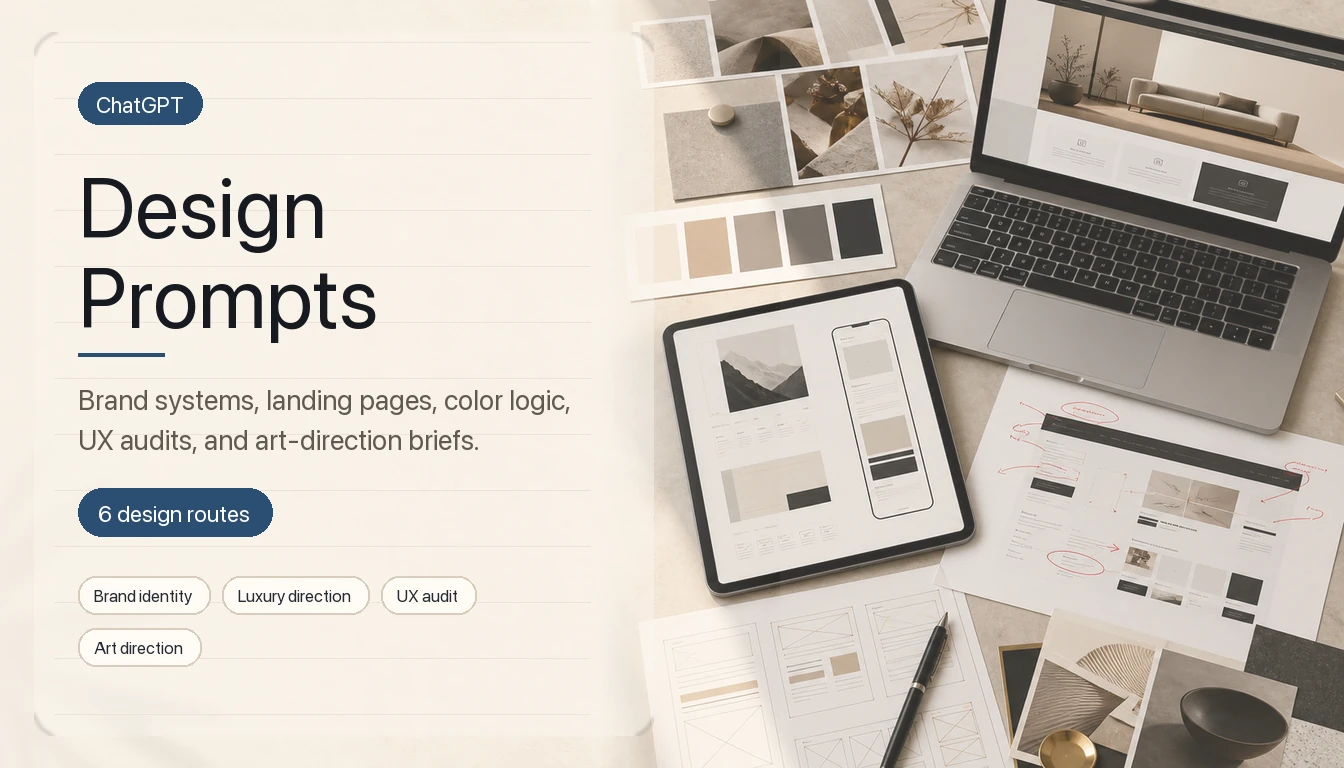
Early brand-system decisions stay easier to change when ChatGPT design prompts pressure-test identity, hierarchy, color logic, and art direction before mockups harden, giving brand designers more room to course-correct. This six-prompt pack is strongest when the design problem is still strategic and structural, not yet narrowed to one ad, one thumbnail, or one short-form growth asset.
Pack Overview
This page covers the design-planning side of the supplied ten-prompt ChatGPT set. The prompts below help with brand identity, luxury styling, landing-page structure, color psychology, UX audits, and art direction briefs. That grouping matters because these prompts are about design decisions and review systems, not campaign-asset volume.
- Route 1: Build a complete visual identity around colors, typography, logo direction, and brand personality.
- Route 2: Reposition a brand toward premium or luxury visual codes.
- Route 3: Structure a conversion-aware landing page before detailed interface design starts.
- Route 4: Choose a color palette based on niche, audience, and behavioral intent.
- Route 5: Audit a website or app concept for usability and conversion problems.
- Route 6: Turn a raw concept into a detailed art-direction brief for image generation or visual production.
Strategic Deployment Guide
Pack model fit: ChatGPT is the direct fit because the source set is framed around ChatGPT-led design assistance, but Claude can still be a useful fallback when one prompt needs longer structured reasoning after the direction is already clear. Keep each run tied to one real brand, one audience, and one design decision, and do not ask a single prompt to replace the whole design process at once.
Prompt 1: Brand Identity Builder
- Target: Founders and brand designers defining a first-pass identity system before visual drift starts.
- Input: Brand name, product category, audience, positioning, and the brand feeling you want people to remember.
- Model fit: ChatGPT for structured identity planning and vocabulary-to-system translation.
- Expected output: Colors, typography, logo direction, visual style, mood, personality, and online appearance rules.
- Quality check: The identity should feel like one coherent system rather than a list of disconnected aesthetic preferences.
Create a complete visual identity for my brand. Define colors, typography, logo direction, visual style, mood, brand personality, and examples of how the brand should appear online.Prompt 2: Luxury Design Direction
- Target: Brands moving upmarket and needing a more premium visual language.
- Input: Current brand style, audience expectations, category norms, and the exact premium cues you want to strengthen.
- Model fit: ChatGPT for premium-positioning translation across color, spacing, imagery, and composition.
- Expected output: Luxury-oriented color psychology, fonts, spacing logic, layout rules, imagery style, and exclusivity signals.
- Quality check: The direction should communicate premium clarity and restraint, not just add gold accents or expensive-sounding words.
Transform my brand into a premium luxury brand. Recommend color psychology, fonts, spacing, layouts, imagery style, and visual elements that communicate exclusivity and trust.Prompt 3: Landing Page Wireframe
- Target: Product and marketing teams structuring a landing page before detailed UI design begins.
- Input: Offer, audience, objections, trust assets, CTA goal, and channel context.
- Model fit: ChatGPT for conversion-aware section sequencing and offer framing.
- Expected output: Hero, trust layers, social proof, offer structure, CTA placement, and visual hierarchy guidance.
- Quality check: The wireframe should explain the order of persuasion, not just list standard website blocks.
Design a landing page structure optimized for conversions. Include hero section, trust elements, social proof, offer positioning, CTA placement, and visual hierarchy.Prompt 4: Color Psychology Specialist
- Target: Designers choosing a palette for a niche, audience, or behavior-focused campaign.
- Input: Niche, target audience, platform context, and the user behavior you want the colors to support.
- Model fit: ChatGPT for explanatory palette logic and behavior-oriented recommendations.
- Expected output: A palette recommendation with color psychology explanations and behavioral implications.
- Quality check: Each color should be justified by audience effect or brand fit, not by generic trend talk alone.
Based on my niche and audience, recommend the perfect color palette. Explain the psychology behind each color and how it influences user behavior.Prompt 5: UI/UX Audit Prompt
- Target: Teams reviewing an app or site concept before launch or redesign.
- Input: Website or app concept, user journey, conversion goal, and known weak spots if available.
- Model fit: ChatGPT for structured usability review and conversion-friction diagnosis.
- Expected output: Usability issues, conversion blockers, visual weaknesses, and actionable improvements.
- Quality check: The audit should identify specific breakpoints in the experience instead of giving generic “simplify the UI” advice.
Review my website/app concept like a senior UI/UX designer. Identify usability issues, conversion blockers, visual weaknesses, and provide actionable improvements.Prompt 6: AI Art Director
- Target: Creatives translating a rough idea into a clearer production brief for image generation or visual execution.
- Input: One idea, one subject, one story goal, and the visual mood or output context.
- Model fit: ChatGPT for detailed creative-brief structure and visual-storytelling articulation.
- Expected output: Composition, lighting, camera angle, color grading, mood, typography, and storytelling direction.
- Quality check: The brief should create a usable visual direction for a human or image model, not just stack cinematic adjectives.
Act as an elite art director. Turn my idea into a detailed creative brief including composition, lighting, camera angle, color grading, mood, typography, and visual storytelling for image generation.Selection Logic
- Start with identity or luxury direction: Use these when the visual identity itself still needs to be defined or repositioned.
- Use the landing-page wireframe prompt for structure: Move here when the main job is landing-page order, persuasion flow, and CTA hierarchy.
- Use color psychology or UX audit for diagnosis: Choose palette psychology when the brand system is underdefined, and choose UX audit when the experience is already visible but underperforming.
- Use the art-direction prompt for brief translation: Bring it in when the idea needs a clearer visual direction for imagery or campaign art.
Implementation Steps
- Phase 1: Choose the prompt that matches the real design job: brand identity, luxury direction, landing page wireframe, color palette, UX audit, or art-direction brief.
- Phase 2: Add one real audience, one platform or landing page context, and one business goal before you run ChatGPT.
- Phase 3: If the output is broad, ask ChatGPT to restate the result as brand rules, page section order, palette logic, or UX audit checkpoints instead of abstract taste language.
- Phase 4: Use the output as a design brief or critique layer, then refine the final interface, brand system, wireframe, or image brief in design tools with human judgment.
Use Cases
- Seed-stage SaaS rebrand: A startup team uses Prompt 1 and Prompt 2 to define its identity deck, homepage visual rules, and investor-facing brand system.
- DTC landing-page rebuild: A growth designer uses Prompt 3 and Prompt 4 to reorganize the sales page, reset trust sequencing, and align the palette with premium conversion cues.
- App redesign review: A product team uses Prompt 5 to produce a UX audit document before sprint planning and stakeholder review.
- Image-generation brief prep: A creative lead uses Prompt 6 to turn one campaign idea into a clearer composition brief for hero visuals, pitch decks, and motion storyboard frames.
Why These Prompts Work
These prompts work because they convert vague aesthetic requests into specific design jobs. Instead of asking for “better design,” the user chooses whether the task is identity building, luxury repositioning, page sequencing, color logic, usability diagnosis, or art-direction framing. That separation improves output quality and makes ChatGPT more useful as a design-planning collaborator rather than a decorative idea machine.
Troubleshooting & Optimization
- The output feels generic: Add the real audience, category pressure, and business goal instead of asking for a style in isolation.
- The identity sounds polished but not usable: Ask ChatGPT to rewrite the result as rules for typography, spacing, color use, and online application examples.
- The wireframe feels templated: Re-enter the specific objection flow, proof assets, and CTA goal so the page structure reflects persuasion order.
- The art direction is too cinematic to execute: Strip out broad adjectives and force Prompt 6 to restate the brief as composition, light source, angle, and focal-subject instructions.
FAQ
- Q: What are ChatGPT design prompts best used for?
A: They are best used for brand, UX, page-structure, palette, and creative-direction decisions where the real problem is design clarity rather than raw image output volume. - Q: Why split these prompts away from thumbnails and ads?
A: Because brand and UX planning serve a different search intent from marketing-asset generation. Splitting the pack keeps both pages more useful and more searchable. - Q: Can these prompts replace a designer?
A: No. They help define direction, structure, and critique language, but the final quality still depends on design judgment and execution. - Q: Which prompt usually creates the biggest shift?
A: Prompt 3 often changes the most, because a strong landing-page hierarchy can improve both conversion performance and later UI decisions at once.
Need the growth-asset half of this source set? Pair this page with the companion article for thumbnails, flyers, carousels, and ad concepts once the brand or UX direction is already clear.
Explore more? View the Image & Design or Prompt Engineering Guides category.
I hope you found this design prompt pack helpful.
Follow me @bigprompt for more.
Like/Repost if you can this prompt.
Internal link:
Claude Book Publishing Prompts That Turn a Finished Manuscript into Cover, Launch, and Revenue Plans
Claude Book Writing Prompts That Carry a Nonfiction Draft from Idea to Edit
Football Celebration Poster Prompt for Team Victory Poster Art
AI Food Prompts for Photography, Advertising, Recipe Graphics, and Video
Claude Design Prompts for Systems, UI, and Marketing Assets
Big Prompt Hub Review
This page is strongest as a ChatGPT-assisted design-planning pack, not as a direct replacement for full design execution. Its value comes from separating identity, luxury positioning, wireframe logic, color psychology, UX review, and art direction into distinct jobs so the user can ask for sharper output with less ambiguity. The deliberate boundary is also a strength: once the task becomes thumbnail CTR, ad-creative volume, or social-asset production, the companion marketing-design page is the better route.