
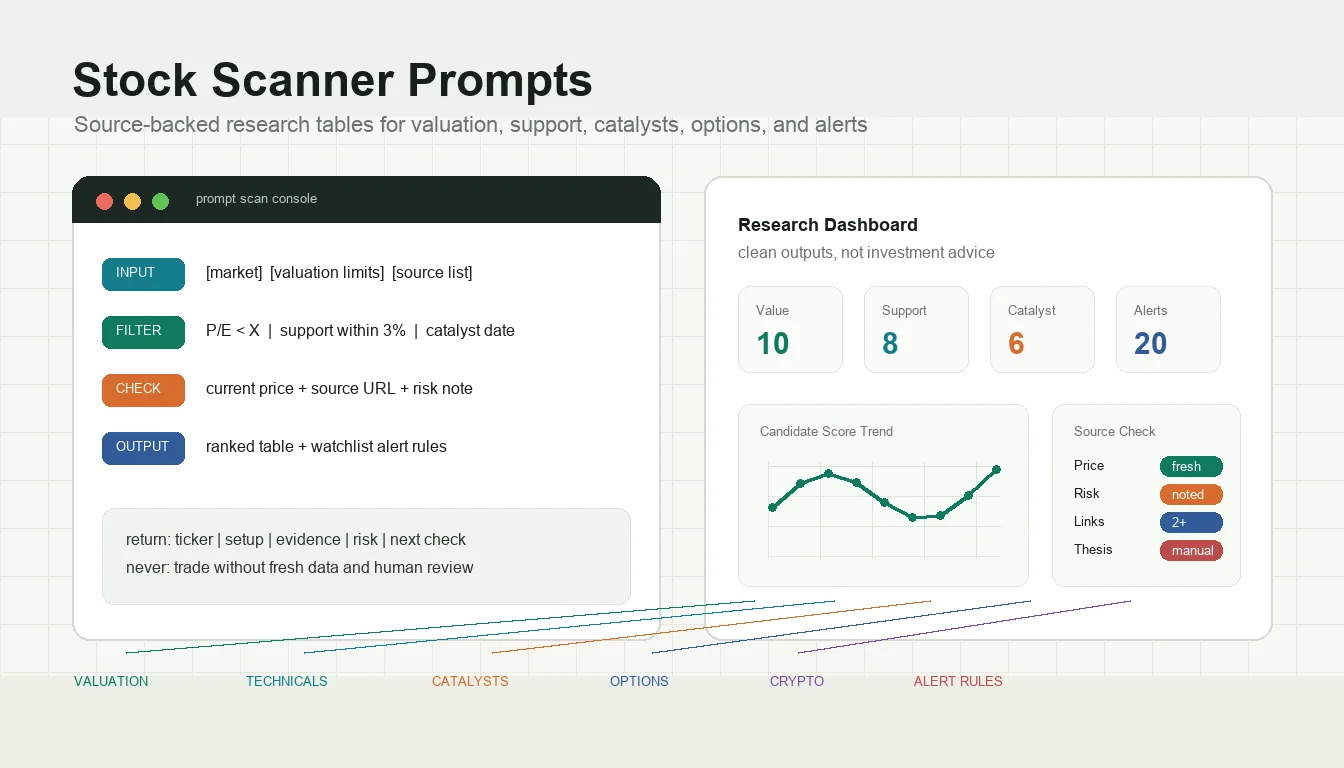
Investors, founders, and finance creators can use stock scanner prompts to split one research session into ten distinct jobs instead of forcing every signal into one filter. The pack helps build watchlists from valuation, technical levels, catalysts, options setups, crypto checks, and alert rules, then pushes users to inspect sources and risk assumptions before acting on any result.
Strategic Deployment Guide
Pack model fit: Use a browsing-capable model only for source collection and first-pass structuring, then lock each scan to one market, one timeframe, and one evidence standard before comparing results. Keep live price checks, filings, chart validation, and final risk decisions outside the model.
Scanner Pack Overview
This pack turns one X thread into a safer research workflow. Use it to gather candidates, compare evidence, and document risk before any human decision, not to automate trades from a single model answer.
- Prompt 1: Find value candidates with fundamentals, news, and source links.
- Prompt 2: Locate liquid stocks near support, RSI, and volume checkpoints.
- Prompt 3: Surface intraday breakout candidates with catalysts and order rules.
- Prompt 4: Combine valuation discounts with near-term catalysts.
- Prompt 5: Build an earnings-week long, short, or volatility playbook.
- Prompt 6: Track sector rotation and ETF ideas from flows and news.
- Prompt 7: Review gap-down recovery setups with stabilization evidence.
- Prompt 8: Scan crypto assets by support, TVL, and ecosystem signals.
- Prompt 9: Compare options ideas around implied volatility and catalysts.
- Prompt 10: Turn today’s candidates into a watchlist and alert rules.
Prompt 1: Undervalued Scanner
- Target: Investors screening value candidates before deeper manual research.
- Input: Market, valuation limits, debt threshold, decline window, and trusted source list.
- Model fit: ChatGPT with browsing for live sources; use spreadsheet review for ratio checks.
- Expected output: A table of tickers, prices, ratios, undervaluation reasons, risks, confidence, and URLs.
- Quality check: Remove any ticker without two working source links and a clear risk note.
Undervalued Scanner Prompt Code
Use web search and reputable financial websites such as Yahoo Finance, Seeking Alpha, Google Finance, company filings, and recent analyst or earnings reports.

Find [ticker count] publicly traded stocks in [market] that appear undervalued today.

Screening criteria:
- P/E < [P/E limit]
- PEG < [PEG limit] or P/B < [P/B limit]
- Debt-to-equity < [debt-to-equity limit]
- Price decline greater than [decline threshold] during [lookback window]

For each ticker, provide:
1. Current price
2. P/E, PEG, and P/B
3. Reason it may look undervalued
4. Recent news, earnings, or sector context
5. Main risk
6. Confidence score from 0 to 10
7. Two source URLs

Present the result in a table. Mark this as research support, not investment advice.
Prompt 2: Technical Support Scanner
- Target: Swing traders and analysts reviewing candidates near visible support.
- Input: Market, liquidity filter, support method, support distance, and timeframe.
- Model fit: ChatGPT for source collection; verify chart levels in TradingView or a broker platform.
- Expected output: Support levels, dates, volume, RSI, entry area, stop, and two targets.
- Quality check: Reject setups where support is not tied to a dated chart level.
Technical Support Scanner Prompt Code
Use web search, chart pages, and market data pages to list [ticker count] liquid stocks in [market] that are within [support distance] of a valid support level.

Valid support can include:
- Recent [lookback period] low
- 50 EMA
- 200 EMA
- Repeated price floor
- Other support method: [support method]

For each stock, provide:
1. Current price
2. Identified support level
3. Date of the relevant low or moving average reading
4. Average volume
5. RSI
6. Suggested entry area
7. Stop-loss level below support
8. TP1 and TP2 targets
9. Chart or article source URLs

Present the output in a table and flag weak or stale chart evidence.
Prompt 3: Intraday Breakout Scanner
- Target: Active traders building a same-day breakout watchlist for manual review.
- Input: Trading date, market, volume multiplier, catalyst types, and timeframes.
- Model fit: ChatGPT for current catalysts; use real-time trading software for execution data.
- Expected output: Tickers, catalysts, timeframe, entry trigger, stop, targets, and order plan.
- Quality check: Confirm volume and catalyst data from live sources before acting.
Intraday Breakout Scanner Prompt Code
Using online market data and news for [trading date], identify [ticker count] tickers in [market] with potential intraday breakout conditions.

Screen for:
- Volume increasing above [volume multiplier] average daily volume
- News, earnings, analyst, or sector catalyst: [catalyst type]
- Gap-up, gap-down, or compression pattern

For each ticker, provide:
1. Recommended timeframe from [timeframes]
2. Entry rule
3. Stop-loss in ticks or percent
4. Take-profit target levels
5. Limit, market, or stop order management note
6. Linked market data and news sources

Add a warning if the setup depends on delayed data.
Prompt 4: Value Catalyst Filter
- Target: Research teams comparing cheap-looking stocks with dated catalysts.
- Input: Market, valuation filters, catalyst window, event types, and risk budget.
- Model fit: ChatGPT for event research; verify dates through investor relations pages.
- Expected output: Six ideas with valuation, catalyst date, bull case, bear case, sizing, and sources.
- Quality check: Remove events that lack a date, filing, calendar entry, or direct source.
Value Catalyst Filter Prompt Code
Search for undervalued stocks in [market] that also have a near-term catalyst within [catalyst window].

Use valuation filters such as:
- [valuation filters]

Allowed catalyst types:
- Earnings
- Restructuring
- Spin-off
- Buyout rumor or confirmed deal
- Regulatory decision
- Product launch
- Other: [event type]

Return [idea count] ideas with:
1. Ticker
2. Valuation ratio
3. Catalyst and expected date
4. Bullish scenario
5. Bearish scenario
6. Suggested position sizing using [risk per idea]
7. Supporting source URLs

Separate confirmed catalysts from speculative ones.
Prompt 5: Earnings Playbook
- Target: Traders comparing earnings setups before choosing a long, short, or volatility plan.
- Input: Market, earnings week, strategy types, options data source, and risk budget.
- Model fit: ChatGPT for calendars and news; use an options platform for IV rank.
- Expected output: Five earnings candidates with date, IV rank, strategy, sizing, risk, and links.
- Quality check: Treat missing IV data as unavailable, not as a model estimate.
Earnings Playbook Prompt Code
For [earnings week] in [market], identify [ticker count] stocks that may be interesting to research around earnings.

Consider strategy types:
- [strategy types]

For each stock, provide:
1. Earnings date
2. IV rank or state unavailable
3. Directional, straddle, strangle, covered, or no-trade idea
4. Position sizing using [risk budget]
5. Biggest risk
6. Calendar, news, and options data sources

Present the result in a table. Do not invent IV rank when no source is available.
Prompt 6: Sector Rotation Filter
- Target: Investors turning macro and flow signals into sector or ETF research ideas.
- Input: Market, ETF universe, flow sources, timeframe, and risk preference.
- Model fit: ChatGPT for source synthesis; confirm levels in ETF charts and flow dashboards.
- Expected output: Five sectors or ETFs with catalyst, timeframe, entry, stop, and two sources.
- Quality check: Separate momentum evidence from actual fund-flow evidence.
Sector Rotation Filter Prompt Code
Perform a quick sector analysis for [market] using recent capital-flow data, sector performance, ETF performance, and news.

Use these flow or news sources when available:
- [flow sources]

Identify [sector or ETF count] sectors or ETFs showing rotation signals.

For each one, provide:
1. Sector or ETF name
2. Rotation reason
3. Data or news catalyst
4. Recommended timeframe: [time horizon]
5. Entry level
6. Stop-loss level
7. Two source URLs

Present the result in a table and label weak evidence clearly.
Prompt 7: Gap Down Recovery Scanner
- Target: Mean-reversion researchers reviewing gap-down stocks after bad news or earnings.
- Input: Market, gap threshold, stabilization signal, lookback window, and risk limit.
- Model fit: ChatGPT for event summaries; chart software should confirm stabilization.
- Expected output: Six gap-down candidates with reason, entry plan, stop, and source links.
- Quality check: Do not include names still selling off without consolidation evidence.
Gap Down Recovery Scanner Prompt Code
Find [ticker count] stocks in [market] that experienced a gap down greater than [gap threshold] during [lookback window].

Only include names showing stabilization evidence such as:
- [stabilization signal]

For each stock, provide:
1. Current price
2. Gap level
3. Reason for the gap
4. Stabilization evidence
5. Mean-reversion entry plan
6. Stop-loss level
7. Supporting source URLs

Present the result in a table and tag each idea as high, medium, or low research quality.
Prompt 8: Crypto Support Scanner
- Target: Crypto researchers comparing technical support with ecosystem or on-chain context.
- Input: Market cap filter, chain or sector, data sources, and time horizon.
- Model fit: ChatGPT for web synthesis; use CoinGecko, DeFiLlama, and explorers for validation.
- Expected output: Eight coins with price, support, TVL or on-chain metrics, news, plan, and sources.
- Quality check: Exclude assets where liquidity, TVL, or source quality is unclear.
Crypto Support Scanner Prompt Code
Using web search and crypto data sources such as CoinGecko, CoinMarketCap, DeFiLlama, project dashboards, and crypto news, find [coin count] cryptocurrencies that appear technically or fundamentally undervalued.

Filters:
- Market cap: [market cap filter]
- Chain or sector: [chain or sector]
- Data sources: [data sources]

For each coin, provide:
1. Current price
2. Key support level
3. TVL or relevant on-chain metric
4. Recent ecosystem or on-chain news
5. Research plan for [time horizon]
6. Supporting source URLs

Present the result in a table and mark liquidity or data-quality concerns.
Prompt 9: Options Edge Scanner
- Target: Options researchers comparing implied volatility, catalysts, and defined-risk structures.
- Input: Ticker universe, expiration window, catalyst type, and IV data source.
- Model fit: ChatGPT for candidate gathering; options pricing must come from a live options platform.
- Expected output: Five option ideas with strategy type, strike, expiration, rationale, risk, and links.
- Quality check: Reject any idea without expiration, strike, catalyst, and data source.
Options Edge Scanner Prompt Code
Search for [idea count] US stocks or ETFs from [ticker universe] where options may show interesting relative value.

Look for:
- High IV rank for premium-selling research
- Low IV for directional buying research
- Near-term catalyst: [catalyst type]
- Expiration window: [expiration window]

For each idea, provide:
1. Ticker
2. Suggested option type or strategy
3. Strike price
4. Expiration date
5. Rationale
6. Main risk
7. Links to IV, options chain, and market data sources

Do not present this as a trade signal. Present it as a research shortlist.
Prompt 10: Watchlist Alert Builder
- Target: Operators building a daily or weekly watchlist from multiple scanner outputs.
- Input: Criterion, ticker count, alert timeframe, volume threshold, and source requirements.
- Model fit: ChatGPT for table consolidation; screener software should run the final alert rules.
- Expected output: A 20-name watchlist with reasons, key levels, triggers, sources, and alert rules.
- Quality check: Every alert rule should be measurable inside the chosen screener.
Watchlist Alert Builder Prompt Code
Use web search and market data sources to build a watchlist of [ticker count] interesting tickers today based on [criterion].

For each ticker, provide:
1. Brief reason for inclusion
2. Key support or resistance level
3. Alert trigger for [alert timeframe]
4. Two supporting source URLs

Then generate [alert rule count] scanner alert rules, such as:
- Volume > [volume threshold] average daily volume and price above EMA50
- Price crossing a stated support or resistance level
- Catalyst published within the last trading session

Format the watchlist and alert rules in separate tables.
Selection Logic
Start with Prompt 1, 2, or 6 when the goal is a slower research list. Use Prompt 3, 5, 7, or 9 only when current data and execution tools are available. Prompt 10 works best after the earlier scans have produced candidates worth tracking.
Implementation Steps
- Audit source freshness: Check quote time, earnings date, and catalyst timestamp.
- Reference every candidate: Keep source URLs beside each ticker row.
- Use table layout: Separate price, trigger, risk, confidence, and source columns.
- Compare duplicates: Keep tickers appearing across multiple screens for manual review.
Use Cases
- Investor newsletter briefs: Build source-backed weekly market commentary.
- Founder treasury watchlists: Monitor sector ETFs and competitor-market signals.
- Finance creator scripts: Compare catalysts, support levels, and risk notes.
- Market study sheets: Teach scanner logic without live trade calls.
Why These Prompts Work
The pack uses constraint satisfaction: each prompt narrows the model with market scope, data fields, filters, source requirements, and output format. That reduces vague ticker lists and pushes the answer toward auditable tables. The repeated Target, Input, Model fit, Expected output, and Quality check structure also makes the prompts easier to reuse across different markets, asset classes, and review cadences.
Troubleshooting & Optimization
- Delayed data: Add a quote timestamp and verify active-market prices.
- Weak sources: Require filings, calendars, chart pages, or data dashboards.
- Overconfident output: Replace trade calls with research shortlist language.
- Mixed timeframes: Separate intraday, swing, and position-trade scans.
FAQ
- Q: How should I use stock scanner prompts safely?
A: Treat the output as a research shortlist. Check source dates, quote freshness, filings, charts, and liquidity before using any idea in a real portfolio or trading plan.
- Q: Can this pack replace a paid screener?
A: It can help explain and organize research, but it does not replace real-time feeds, broker tools, chart platforms, or professional risk controls.
- Q: Which model works best with these research prompts?
A: Use a browsing-capable model for source collection and a spreadsheet or finance tool for validation. The model should cite data, not invent ratios.
- Q: What should I add for crypto or options screens?
A: Add data-source requirements. Crypto screens need liquidity, TVL, and on-chain sources; options screens need IV, expiration, strike, and catalyst data.
Use this prompt to generate your version? Share in the comments or on Twitter!
Explore more? View the Business & Productivity or Prompt Engineering Guides category.
I hope you found this stock scanner research AI prompt helpful.
Follow me @bigprompt for more.
Like/Repost if you can this prompt.
Internal link: Create Paper Cut Collage Prompt Scenes with Childlike Crayon Style
Internal link: Create World Cup Team Poster Prompt Assets for National Team Campaigns
Internal link: Build AI Video Ads with GPT Image 2 Seedance Workflow
Internal link: Create Scrapbook Travel Poster Prompt Layouts for Cities
Internal link: Create Travel Poster Prompt Assets with Boarding Pass Scenes
Big Prompt Hub Review
This research pack is useful because it keeps each scan tied to inputs, source links, and review criteria instead of asking the model for loose ticker ideas. Its main limit is data reliability: market quotes, IV rank, liquidity, and catalyst timing still need platform-level validation. The pack fits finance creators, analysts, and operators who want repeatable research tables with human judgment left in the loop.