
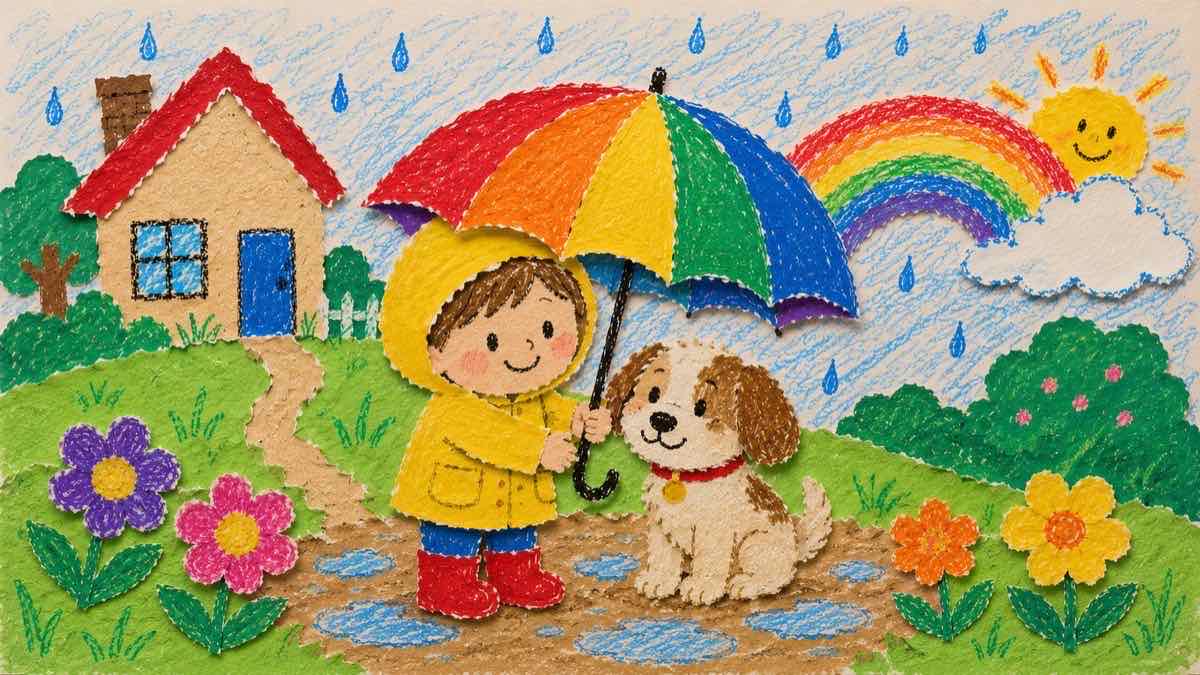
Teachers, parents, and children’s brands can use a paper cut collage prompt to balance torn layers, crayon edges, and shallow handmade depth inside one readable scene. Print sellers can reuse the same structure for nursery art, classroom visuals, and cheerful product mockups that feel assembled by hand rather than rendered as polished vector art.
Image Example


Strategic Deployment Guide
Model fit: ChatGPT (GPT Image 2) first. Swap subject, season, palette, and doodle accents, then keep the paper-crayon split balanced.
Paper Cut Collage Prompt Code
CORE BRIEF:
Create a charming mixed-media illustration of [subject or scene], blending handmade paper-cut collage with naive children's crayon drawing in a balanced 50/50 style. The image should feel like a real school craft project made by hand, not a polished digital vector poster.

PAPER COLLAGE FOUNDATION:
Build the main scene from torn construction-paper pieces in [paper palette]. Use visible layered paper shapes, uneven ripped edges, slight overlap shadows, matte texture, and handmade depth. Each major object should read as a cut paper shape before any crayon detail is added.

CRAYON DRAWING SYSTEM:
Add wax-crayon details in [crayon accent colors] as playful outlines, scribbles, rough shading, loose hatch marks, and simple facial expressions. Keep the crayon childlike and imperfect, but do not let it overpower the torn-paper collage structure.

SUBJECT AND SILHOUETTE CONTROL:
Keep the composition simple enough for a child-made visual logic. Use [main shapes], rounded silhouettes, wobbly proportions, and friendly facial features. If the scene includes people or animals, give them soft black-dot eyes, small smiles, and clear readable poses.

BACKGROUND STAGING:
Set the artwork in [background mood] with [weather or season cues], [simple scenery props], and broad areas of crayon sky or ground texture. The environment should support the main subject without getting too detailed or realistic.

HANDMADE DETAIL RULES:
Use glue-like layering depth, slightly misaligned pieces, rough paper seams, visible texture grain, and simple craft-class decoration such as [extra doodles or ornaments]. Keep everything tactile, bright, innocent, and endearingly imperfect.

STYLE BALANCE:
Maintain a true 50/50 balance between collage and crayon. The paper layer should define shapes, while the crayon layer adds personality, motion, and childlike charm. Avoid turning the result into full sketch art or full paper mosaic.

COLOR AND MOOD:
Use bright cheerful color blocking with [main color family], soft contrast, and no dark cinematic grading. The scene should feel joyful, safe, tactile, and suitable for children's visuals, classroom decor, and playful family-friendly branding.

NEGATIVE PROMPT:
Avoid photorealism, polished vector edges, glossy digital gradients, realistic anatomy, adult facial proportions, complex perspective, heavy shadows, painterly brushwork, messy clutter, text overlays, hyper-detailed backgrounds, or any crayon layer that fully covers the torn-paper structure.

OUTPUT FORMAT:
Generate one clean high-resolution illustration in [format or aspect ratio] suitable for posters, nursery prints, classroom materials, children's product mockups, greeting cards, or storybook concept boards.
Why This Framework Functions
This framework works because it uses texture separation as a control system. Torn paper establishes silhouette hierarchy, overlap shadows, edge rhythm, and readable shape logic, while crayon handles gesture, warmth, and childlike imperfection. That modality split prevents the common failure where mixed-media prompts collapse into either a flat scribble drawing or a sterile paper mosaic with no personality.
Implementation Steps
- Lock the subject: Reduce the scene to broad cut-paper silhouettes first.
- Balance media roles: Let paper hold shape and crayon hold personality.
- Swap props as a bundle: Change season, scenery, and palette together.
- Leave text for later: Add titles in Canva or Figma after generation.
Application Scenarios
- Nursery wall art: Gentle handmade animal or weather scenes for printable decor mockups.
- Classroom materials: Seasonal posters, reading-corner art, or reward-chart illustrations with child-safe styling.
- Children’s brand moodboards: Packaging or campaign concepts for toys, books, learning apps, and family products.
- Storybook concept boards: Early scene exploration before committing to a more polished illustration pipeline.
Why This Prompt Works
This paper cut collage prompt succeeds because it follows a medium-role separation control principle. Paper controls edges, layers, and object readability, while crayon handles emotion, looseness, and kid-made energy. That prompt-engineering control gives the model less room to muddy the texture mix, so the output stays tactile, bright, and reusable across seasons, animals, home scenes, and classroom subjects.
Troubleshooting & Optimization
- Too much crayon noise: Append paper collage remains dominant; crayon used only for outlines, scribbles, and light shading.
- Paper edges look too clean: Append visible torn edges, rough seams, uneven cuts, handmade overlap shadows.
- Faces look too realistic: Append simple childlike facial features, black-dot eyes, tiny smiles, naive proportions.
- Scene gets too busy: Append flat composition, broad shapes, limited props, simple school craft logic.
Mixed-Media Collage FAQ
- Q: What makes a paper cut collage prompt different from a generic children’s illustration prompt?
A: A stronger paper cut collage prompt separates structural paper layers from crayon decoration. That keeps the result tactile and handmade instead of drifting into flat cartoon drawing or clean digital cutout art. - Q: Which subjects work best with this mixed-media setup?
A: Weather scenes, garden animals, classroom moments, holiday crafts, nursery themes, and simple family-friendly storytelling subjects work especially well. The format likes broad silhouettes, bright palettes, and emotionally readable poses. - Q: Which model works best for this handmade collage style?
A: ChatGPT with GPT Image 2 is a strong first choice when you need shape clarity and stable mixed-media balance. You can test Gemini for faster variation passes, but you should still compare edge texture, crayon restraint, and handmade depth before publishing.
Use this prompt to generate your version? Share in the comments or on Twitter!
Explore more? View the Image & Design or Fun & Creative category.
I hope you found this paper-cut collage AI prompt helpful.
Follow me @bigprompt for more.
Like/Repost if you can this prompt.
Internal link:
Create World Cup Team Poster Prompt Assets for National Team Campaigns
Build AI Video Ads with GPT Image 2 Seedance Workflow
Create Scrapbook Travel Poster Prompt Layouts for Cities
Create Travel Poster Prompt Assets with Boarding Pass Scenes
Create Logistics Ad Poster Prompt Assets for Courier Campaigns
Big Prompt Hub Review
This childlike collage template is useful when you need a reusable craft style instead of a one-off cute image. Its main strength is the balanced media logic: torn paper handles silhouette and depth, while crayon adds personality without taking over the frame. The main limits are overcrowded scenes, overly polished edges, and faces that become too realistic if you skip the naive-style constraints.