
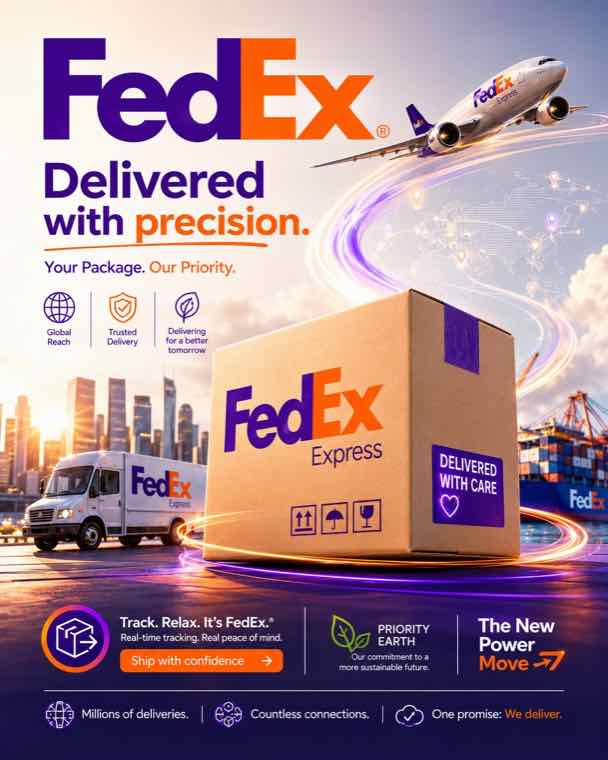
Marketers, agencies, and logistics brands can use a logistics ad poster prompt to give the package, route, trust message, and CTA separate jobs inside one readable 4:5 asset. The template works best when the hero object, route layer, and CTA zone stay fixed while the brand-specific promise and coverage cues change.
Image Examples


Strategic Deployment Guide
Model fit: ChatGPT (GPT Image 2) for brand-controlled poster structure; Gemini for fast variations. Keep one hero package or vehicle, one route-graphic layer, and one CTA zone fixed, then swap brand, palette, service promise, map cue, and channel.
Logistics Ad Poster Prompt Code
BRAND IDENTITY SYSTEM:
Create a high-end vertical 4:5 logistics ad poster for [logistics brand]. Keep the source logic centered on one package or vehicle hero, one readable route layer, one trust message, and one CTA zone. Use [approved palette] and [approved wordmark or placeholder] only. Do not invent logos, slogans, partnerships, statistics, or claims.

CAMPAIGN POSITIONING:
Build the poster around this core message: [campaign promise]. The visual should make logistics feel fast, reliable, trackable, careful, and modern. Use a trust-in-motion idea, where every package, route, and delivery signal reinforces confidence instead of clutter.

CORE COMPOSITION AND LAYOUT:
Use a vertical 4:5 layout for Instagram, LinkedIn, and X hero posts. Create a modern asymmetric grid with a clear headline zone, hero image zone, support icon row, metric panel, and bottom CTA area. Keep enough negative space for readable social copy and post-render typography repair.

HERO OBJECT AND SCENE:
Place [delivery hero object] as the main focal point. It can be a branded package, freight box, delivery van, cargo aircraft, warehouse dock, or route control dashboard. Add [supporting logistics elements] such as route arcs, map nodes, truck silhouettes, aircraft trails, tracking icons, or warehouse details. Keep the scene commercial, clean, and believable.

VISUAL STORY SYSTEM:
Show [customer benefit] through motion, care, reach, and visibility. Use [regional or service coverage cue] only as a subtle graphic layer, not as a noisy background.

TEXTURE, CAMERA, AND LIGHTING:
Use commercial product photography with CGI precision. Show tactile package material, clean edges, realistic shadows, and controlled highlights. Lighting should use a cinematic soft key from the upper left, gentle fill, and slight rim light to create volume and forward motion. Keep typography sharp and readable at thumb size.

COPY AND CTA SYSTEM:
Include [campaign headline], [supporting tagline], [three service proof points], and [call to action]. Leave small legal, tracking, metric, and app copy as clean placeholder panels if exact wording is not verified.

PRODUCTION FORMAT:
Generate a high-resolution 4:5 poster suitable for social media previews, paid ad mockups, brand presentation boards, and campaign concept review. Leave clean margins for rebuilding logos, statistics, CTA text, and icons in Figma, Photoshop, or Illustrator.

NEGATIVE PROMPT:
Avoid invented logos, fake brand claims, wrong colors, distorted wordmarks, unlicensed marks, fake partnerships, messy route graphics, unreadable microcopy, broken typography, cluttered icons, low contrast, flat sterile minimalism, excessive photorealistic detail, hand-drawn effects, doodle style, crayon texture, risograph texture, naive illustration, distorted vehicles, warped packages, and crowded backgrounds.
Why This Framework Functions
The framework separates brand identity, campaign promise, composition, material texture, route graphics, and text zones before asking for polish. That order helps the image model stabilize logo placement, palette control, object hierarchy, and motion cues. It also reduces false claims by telling the model to leave unverified statistics, CTAs, and small legal text as editable panels.
Implementation Steps
- Lock brand assets: Use official palette, wordmark rules, and authorized logo file.
- Set package hero: Choose delivery object, surface material, and camera angle.
- Reserve typography zones: Leave headline, CTA, and metric panels for post-render repair.
- Repair small text: Rebuild stats, CTA, and icons in Figma before publishing.
Application Scenarios
- Courier brand launches: 4:5 hero posts for new service announcements.
- B2B logistics pitches: Trust visuals for LinkedIn and sales decks.
- Ecommerce delivery campaigns: Package-led assets for marketplace shipping promises.
- Regional network ads: Route-map posters for city or country coverage.
Why This Prompt Works
This logistics ad poster prompt works through constraint satisfaction and variable grounding. Brand rules, palette, logo authorization, hero object, and route-map layers are defined before camera style. The negative prompt then blocks common drift: fake marks, broken typography, cluttered maps, and unverifiable metrics. That structure gives the model a clearer hierarchy for commercial social visuals.
Troubleshooting & Optimization
- Logo drifts: Replace with: use authorized logo file only; no invented marks.
- Text breaks: Append: leave blank text panels; rebuild copy in Figma.
- Poster clutters: Replace route graphics with minimal thin connection lines.
- Brand feels generic: Add official palette, service promise, and package material cues.
Common Questions
- Q: What is a logistics ad poster prompt used for?
A: It helps create social campaign poster concepts for courier, freight, ecommerce delivery, warehouse, or last-mile logistics brands. The best use is concept development before a designer rebuilds logos, small text, statistics, and final typography with verified assets. - Q: Can I use it with real brands?
A: Yes, but only when you have permission to use the logo, colors, slogans, statistics, and brand claims. For public posting or ads, replace generated marks with authorized files and check every business claim before publishing. - Q: Which model fits this layout best?
A: ChatGPT with GPT Image 2 is a strong fit for controlled layouts and brand-following. Gemini can produce useful style variations, but both models still need manual logo, typography, and legal-claim cleanup before commercial use.
Use this prompt to generate your version? Share in the comments or on Twitter!
Explore more? View the Image & Design or Marketing & Growth category.
I hope you found this logistics ad poster generation AI prompt helpful.
Follow me @bigprompt for more.
Like/Repost if you can this prompt.
Internal link:
Build Apps from Idea to Launch with Claude Mobile App Prompts
Create World Cup Poster Prompt Infographics for Match-Day Campaigns
Create Food Advertising Poster Prompt Layouts for Restaurants
Scale Creative Prints via Watercolor Illustrated Calendar Poster Prompt
Big Prompt Hub Review
This prompt has strong commercial reuse value because it treats logistics advertising as a system: brand identity, package hero, route motion, trust message, CTA, and editable text zones. Its main risk is brand accuracy. Use it for concept direction, then replace generated logos, metrics, icons, and small copy with approved assets before client delivery or final paid social media placement.
Comments
One response to “Logistics Ad Poster Prompt: Courier Routes, Trust, and CTA Space”
Buy With Context | Practical Buying Guides for Tech, Home & Travel Gear
Practical buying guides that explain who a product is for, who should skip it, and what to compare before buying.