
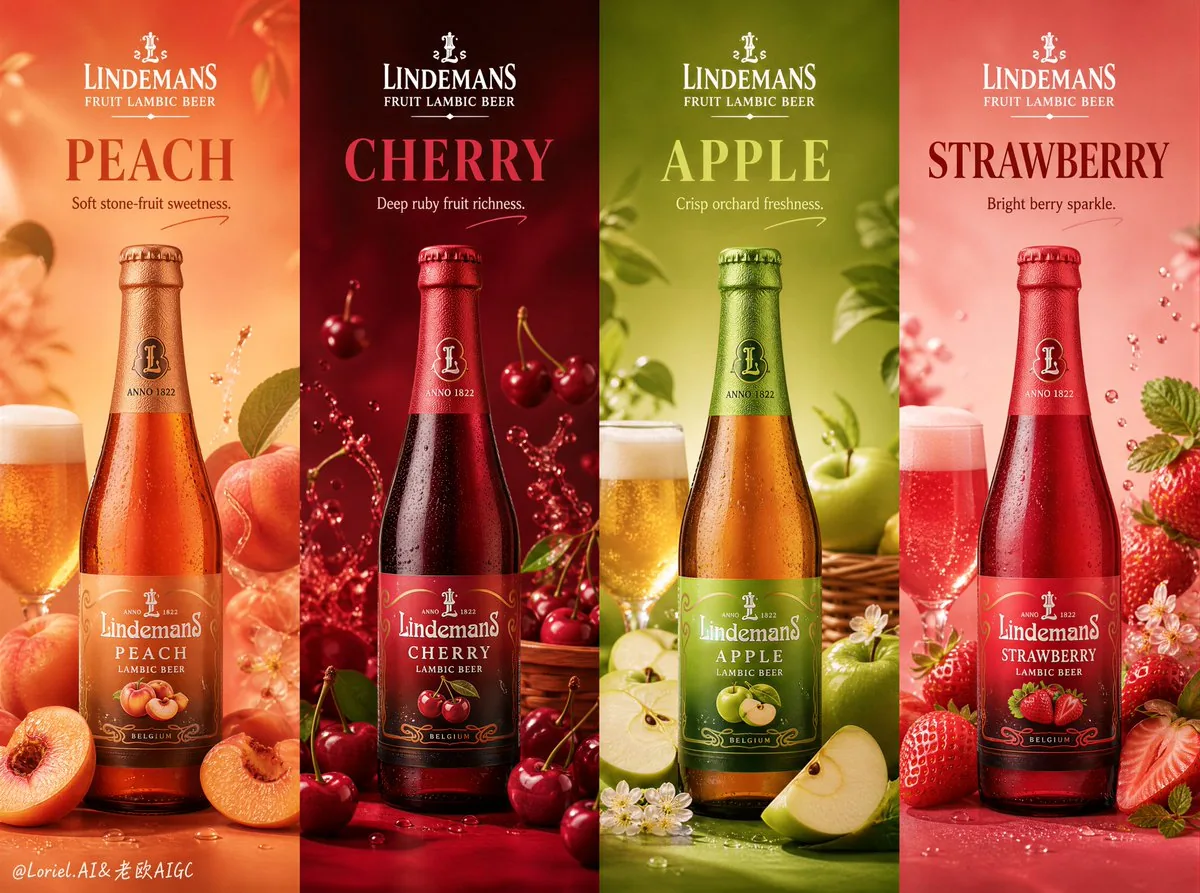
Beverage marketers and packaging designers reach for a fruit beer poster prompt when four documented flavors need to read as one polished landscape campaign. The system keeps bottle scale, panel order, fruit cues, and English copy consistent enough for a launch review while leaving brand claims and final labels to human approval.
Image Examples

Strategic Deployment Guide
Model fit: GPT Image 2 is preferred for this ordered landscape brief because it can balance four repeated product placements, readable type zones, glass reflections, and fruit texture on one canvas. If it is unavailable, use the steadiest current image model for structured grids. Attach a rights-cleared bottle reference when label identity matters, fill every flavor and copy variable, and proof generated text before release.
Fruit Beer Poster Prompt Code
CAMPAIGN IDENTITY:
Brand and brand line: [rights-cleared brand and brand line]
Flavor lineup in order: [flavor 1], [flavor 2], [flavor 3], [flavor 4]

Create one ultra-premium horizontal four-panel beverage advertising poster. Divide one wide landscape canvas into four equal vertical flavor panels that read as one unified series, not four unrelated images.

PRODUCT AND PLACEMENT:
Each panel contains one realistic [bottle or package format], one matching fruit accent or beer interaction, one flavor title, one short supporting line, and restrained brand presence. Keep all four bottles exactly the same apparent size, camera height, framing, and central or slightly lower-central anchor. Every bottle must be fully visible and aligned across the shared baseline.

COMPOSITION WITHIN EACH PANEL:
Reserve negative space above or beside the bottle for the flavor title and supporting line. Keep fruit accents secondary, balanced around the product, and clearly connected to the corresponding liquid color and flavor world.

FLAVOR IDENTITIES:
Flavor 1 identity and mood: [fruit evidence, liquid color, background mood, emotional cue, and supporting line]
Flavor 2 identity and mood: [fruit evidence, liquid color, background mood, emotional cue, and supporting line]
Flavor 3 identity and mood: [fruit evidence, liquid color, background mood, emotional cue, and supporting line]
Flavor 4 identity and mood: [fruit evidence, liquid color, background mood, emotional cue, and supporting line]
Make the four emotional worlds immediately distinct while keeping one premium family: mellow stone fruit, deep red fruit, crisp orchard freshness, and bright berry sparkle are example directions. Use controlled variation across flavors rather than changing the camera system.

COLOR, TYPE, AND BRANDING:
Background palette: [four premium background colors mapped to the four flavors]
Use English-only typography with the approved brand line, a large flavor title, and one short supporting line in each panel. Keep type bold, modern, refined, and legible; add only a tiny underline, flourish, or arrow when it clarifies the flavor cue.

REALISM AND LIGHTING:
Render crisp glass thickness, believable reflections, label detail, fruit-tinted liquid transparency, restrained condensation, and tactile fresh fruit. Use soft high-end studio lighting, short controlled shadows, micro highlights, and a clean editorial surface. Keep fruit and splash accents secondary to the bottles.

NEGATIVE CONSTRAINTS:
Avoid [cropped bottles, inconsistent scale, floating products, clutter, plastic fruit, fake glass, unreadable typography, noisy backgrounds, cartoon rendering, oversaturated chaos, flat lighting, and low-resolution texture].

OUTPUT:
Canvas and delivery use: [target canvas, aspect ratio, print or screen use, safe margins, and export format]
Deliver one balanced, immediately readable horizontal four-panel campaign image. Treat generated labels and claims as drafts requiring human verification.
Implementation Steps
- Document the lineup: Supply four approved flavor names, fruit evidence, brand line, package reference, and one short supporting line for each panel.
- Lock the landscape grid: Set equal vertical panels, reading order, safe margins, shared baseline, bottle anchor, and type zones before styling.
- Map flavor evidence: Give each flavor a documented fruit cue, liquid color, background, and mood; do not invent health or product claims.
- Generate one coherent pass: Keep bottle scale and placement identical. Do not splice four unrelated outputs into a grid; use post-render layout repair and approved vector typography for corrections.
- Proof the delivery asset: Check labels, reflections, bottle visibility, panel order, contrast, and portrait/mobile crops in a design tool before release.
Application Scenarios
- Beverage marketers launching a seasonal line: Introduce four documented flavors in one collectible social campaign or landing-page hero.
- Bottle-shop and tasting-room operators: Give a retail menu landing-page asset or tasting-flight campaign a consistent visual row while keeping each flavor easy to scan.
- Packaging art directors: Compare color, fruit evidence, and label hierarchy before commissioning final beverage photography and production artwork.
- Creative agencies building client concepts: Test rights-cleared beverage lineups without losing the aligned product system that makes the series feel premium.
Why This Prompt Works
The prompt separates a fixed display system from replaceable beverage data. Equal vertical panels and a shared bottle baseline create continuity, while fruit, liquid color, background, and mood variables make each flavor distinct. Glass, label, lighting, and negative constraints protect the premium read, and human proofing keeps generated packaging text from becoming an unapproved claim.
Troubleshooting & Optimization
- The bottles drift: Restate equal panel widths, shared baseline, identical camera height, and fully visible products.
- Flavor worlds look alike: Increase evidence-based contrast in fruit, liquid tint, background, and supporting line while keeping type consistent.
- Glass looks plastic: Reduce decorative effects and restate glass thickness, reflections, liquid depth, and restrained condensation.
- Labels are wrong: Treat generated type as a draft, then replace it with approved vector artwork or correct it in a design tool.
- The crop loses a panel: Use safe margins and test wide, square, and portrait crops before publishing.
Common Questions About Fruit Beer Poster Prompts
- Q: What does a fruit beer poster prompt control?
A: It controls the four-panel landscape, aligned bottle heroes, flavor evidence, palette, typography, lighting, and output settings while leaving brand data replaceable. - Q: Can I change the brand and fruit lineup?
A: Yes. Replace them with rights-cleared packaging, documented flavors, approved copy, and new fruit cues while retaining the equal-panel display system. - Q: Should the model invent beer claims?
A: No. Supply approved wording and have the responsible brand team verify every label, descriptor, and legal claim. - Q: Is this a substitute for final beverage photography?
A: It is a concept and campaign exploration tool. Final packaging, legal copy, and production photography still require the responsible creative and brand teams.
Use this prompt to explore a fruit-beer campaign, then share the result in the comments after checking rights, labels, and crop safety.
Explore more visual systems in Image & Design and Prompt Engineering Guides.
I hope you found this fruit beer poster prompt useful.
Follow @bigprompt for more prompts and workflow systems.
Related Big Prompt Hub pages:
Ice Cream Poster Prompt for a Premium 2×2 Flavor Campaign
Fast Food Poster Prompt for a Six-Panel 2×3 Menu Campaign
Real Fruit Juice Poster Prompt for Product-Focused Campaigns
Juice Advertising Poster Prompt for Premium Beverage Visuals
English Novel Cover Prompt for Story-Led Book Jackets
Big Prompt Hub Review
This is a useful concept-stage asset for teams that need four beverage flavors to feel collectible and consistent in one wide visual. Its strength is the disciplined relationship between bottle placement, fruit evidence, color, and typography; it does not approve trademarks, package copy, legal claims, or final photography. Use the variable block as the creative brief, then have a designer and responsible brand team verify every public-facing detail.