
Tournament designers sequencing matchday football poster prompts need more than one attractive football image. A useful campaign set usually needs a venue atmosphere visual, a player hero asset, and a country or trophy graphic that can carry recap, fixture, sponsor, or fan-content variations without inventing match facts.
Workflow Example

Workflow Overview
This workflow turns existing football prompt assets into a three-part poster route. Start with the match location and crowd story, then build the hero-player key visual, then close with a trophy or country campaign poster. Keep every factual detail as a verified input: team names, match date, stadium, tournament, score, sponsor, and broadcast copy should come from a real brief, not the image model.
- Prompt 1: Build the matchday venue scene with a stadium map, supporters, city context, and one defining match moment.
- Prompt 2: Create a player hero poster for the key visual, social card, or player-feature announcement.
- Prompt 3: Create a trophy or country campaign poster for recap, sponsor, or tournament identity use.
Prompt 1: Matchday Venue Map Poster
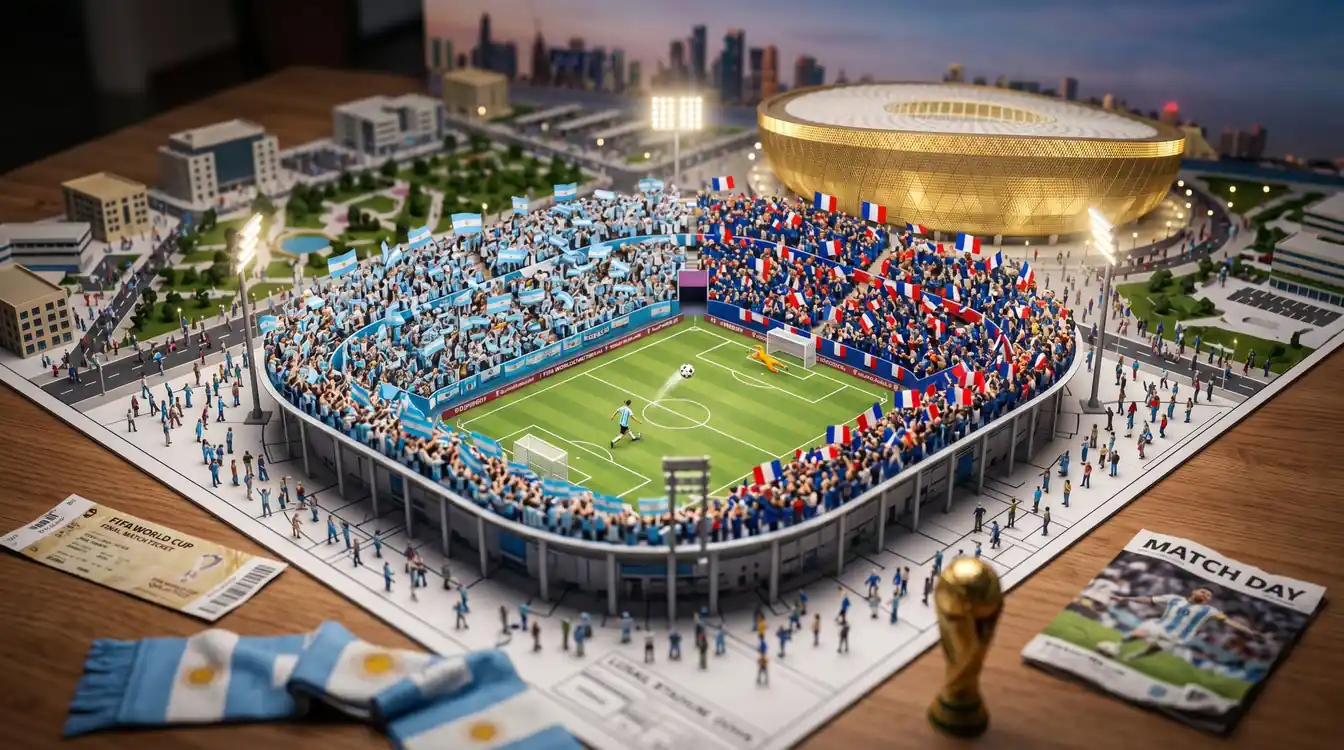
Use this first when the campaign needs place, crowd, and atmosphere. It turns a stadium map into a miniature match world, so the rest of the set has a clear location and emotional anchor.
- Target: Tournament designers, club media teams, and fan-content creators announcing a fixture or building a matchday scene.
- Input: Stadium, city, team names, opponent, tournament, match moment, colors, and confirmed venue details.
- Model fit: Use an image model that handles miniature scenes, tilt-shift detail, and architectural atmosphere; review small text manually.
- Expected output: A stadium-map diorama poster with crowd energy, city spillover, pitch action, and memorabilia around the map.
- Quality check: Reject outputs where the stadium becomes generic, the match moment is unreadable, or the model invents unverified fixture data.
Matchday Venue Map Poster Prompt Code
LAYOUT STRUCTURE AND COMPOSITION CONTROLS:
Create a cinematic football stadium map poster for [stadium], [city], transformed into a living miniature matchday world.

VISUAL CONTROLS:
Show the match as [team] versus [opponent] in [tournament]. The pitch rises from the printed map, with thousands of tiny supporters filling the stands, waving flags, scarves, and banners in verified team colors.

Freeze the defining moment: [match moment]. Add miniature city streets around the stadium, fans walking toward the ground, glowing floodlights, match tickets, supporter scarves, and football memorabilia placed around the map like physical campaign props.

IDENTITY CONTROL:
Maintain the specific venue identity of [stadium], the city identity of [city], and consistent team color identity across flags, scarves, banners, and crowd sections.

SCENE LOGIC:
Keep the sequence readable as one matchday scene: map surface first, rising pitch second, crowd movement third, and frozen match moment as the final focal point.

STYLE DIRECTION:
Use a cinematic miniature-world look with premium sports-poster clarity, believable crowd scale, and a readable stadium-map base.

PRODUCTION FORMAT:
Use championship atmosphere, ultra-detailed miniature worldbuilding, tilt-shift photography, cinematic evening lighting, photorealistic crowd detail, emotional storytelling, and a premium sports-poster finish.

NEGATIVE PROMPT:
Avoid invented match facts, fake sponsor names, unreadable fixture text, generic stadium bowls, wrong team colors, distorted crowds, messy typography, and clutter that hides the pitch.
Prompt 2: Player Hero Key Visual
Run this after the venue poster. It gives the campaign a human focal point: a player portrait, action pose, surname structure, number, and color slice that can work as the main social or editorial key visual.
- Target: Sports designers creating star-player announcements, editorial match previews, or player-led campaign cards.
- Input: Player name, player number, team or country colors, pose, campaign line, and rights-approved likeness direction.
- Model fit: Use a strong image model for commercial sports lighting and portrait composition; do rights and likeness review before public commercial use.
- Expected output: A premium football editorial hero poster with a sliced portrait, action figure, large surname, number, and stadium texture.
- Quality check: Reject outputs with wrong identity cues, distorted anatomy, fake kit marks, unreadable player text, or overstuffed visual effects.
Player Hero Key Visual Prompt Code
LAYOUT STRUCTURE AND COMPOSITION CONTROLS:
Create a premium football editorial hero poster for [player name] from [team or country].

VISUAL CONTROLS:
Build a layered sports-advertising composition with one massive monochrome background portrait, a clean colored slice across the eyes using [primary team color], and one dynamic foreground action pose such as [pose or celebration].

Add oversized vertical outlined surname typography, the player number [number], subtle stadium silhouette, paper texture, concrete texture, controlled smoke or dust, and premium editorial lighting. Keep the kit team-inspired but avoid exact copyrighted badges unless the brief has clearance.

IDENTITY CONTROL:
Keep the face, likeness direction, body shape, hairstyle, kit color identity, and player number consistent with the rights-approved reference brief.

SCENE LOGIC:
Keep the visual sequence simple: background portrait establishes identity, eye-slice creates campaign tension, foreground action pose delivers the matchday moment.

STYLE DIRECTION:
Use an elite editorial football style with bold portrait contrast, restrained typography, and campaign-ready negative space.

PRODUCTION FORMAT:
Use high-contrast commercial sports lighting, rim light, cinematic shadows, sharp editorial hierarchy, and clean negative space.

NEGATIVE PROMPT:
Avoid wrong identity, wrong hairstyle, wrong jersey colors, extra limbs, distorted faces, plastic skin, watermarks, fake sponsor marks, messy typography, and excessive effects that weaken the player hierarchy.
Prompt 3: Country Trophy Campaign Poster
Use this third when the set needs a broader tournament graphic that is not tied only to one stadium or one player. It is useful for sponsor posts, national-team hype cards, recap covers, and merchandise-style campaign art.
- Target: Tournament marketers, football publishers, and design teams building country-led campaign visuals.
- Input: Country, national colors, trophy role, approved symbols, campaign slogan, product format, and event context.
- Model fit: Use an image model that handles object collage, bold silhouettes, and clean advertising composition.
- Expected output: A 4:5 country football ad built around a trophy silhouette, national palette, football props, and campaign-ready hierarchy.
- Quality check: Verify symbols, colors, flags, and copy manually; remove any invented claim, fixture, price, sponsor, or official mark.
Country Trophy Campaign Poster Prompt Code
LAYOUT STRUCTURE AND COMPOSITION CONTROLS:
Create a professional 4:5 football campaign advertisement for [country].

VISUAL CONTROLS:
Use [country colors] as the clean vibrant backdrop. Build a bold trophy-shaped composition from football items, national visual symbols, supporter props, kit-inspired textures, local cultural cues, and campaign objects approved for [event or match].

Place the trophy silhouette at the center with clear advertising hierarchy. Add a short campaign line: [campaign line]. Keep all text minimal, readable, and easy to replace later in a design tool.

IDENTITY CONTROL:
Preserve the national identity, trophy identity, palette identity, and approved football-culture symbols without mixing unrelated countries or fake official marks.

SCENE LOGIC:
Treat the poster as a campaign scene rather than a random object pile: trophy silhouette first, national symbols second, short campaign line third.

STYLE DIRECTION:
Use polished tournament advertising with clean object hierarchy, national color restraint, and trophy-first readability.

PRODUCTION FORMAT:
Use premium commercial lighting, crisp object edges, balanced negative space, national celebration energy, realistic football materials, and a polished tournament-poster finish.

NEGATIVE PROMPT:
Avoid fake official marks, invented sponsors, wrong flag colors, unreadable text, cluttered object piles, generic trophy stock art, political symbols, and any unverified match result or schedule claim.
Implementation Steps
- Lock the real match brief first: Confirm teams, venue, date, tournament name, broadcast/sponsor constraints, and permitted player or badge usage before generating.
- Generate the venue poster before the hero poster: The stadium map sets the atmosphere, palette, crowd density, and match moment for the rest of the set.
- Keep typography editable: Let the model suggest hierarchy, but rebuild final fixture text, scorelines, sponsor copy, and small labels in Figma, Photoshop, Illustrator, or Canva.
- Use one palette bridge: Pull one shared accent color from the venue scene into the player poster and trophy poster so the campaign feels like a set.
- Run a rights pass: Check player likeness, federation marks, club badges, sponsor marks, and tournament names before using the result in paid or official contexts.
Workflow Use Cases
- Match announcement sets: Use the venue map as the opener, then post the hero-player card closer to kickoff.
- Fan media editors: Build a three-slide sequence: stadium atmosphere, key player, and country/trophy celebration graphic.
- Sponsor campaign designers: Keep sponsor placement as a design-tool layer so legal and brand teams can approve it separately.
- Sports editors: Use verified match facts to create preview art before the match and adjust the trophy poster after the result is official.
Application Scenarios
- Club media teams: Produce fixture announcement graphics for Instagram, X, and matchday landing pages.
- Tournament sponsors: Mock up brand-safe campaign posters that separate sponsor copy from generated artwork.
- Football publishers: Create editorial preview covers, player spotlight visuals, and post-match recap thumbnails.
- Fan creators: Build carousel sets for supporter pages, fantasy match previews, and collectible tournament art drops.
Troubleshooting & Optimization
- The venue poster looks generic: Add recognizable stadium roof geometry, verified city landmarks, exact stand color pattern, and matchday memorabilia around the printed map.
- The player poster loses identity: Replace celebrity-specific wording with rights-approved attributes, then append consistent hairstyle, correct body shape, verified kit color palette, no random face changes.
- The trophy poster becomes cluttered: Limit the object list to five approved symbols and append clean trophy silhouette, large negative space, simple campaign line, no dense collage.
- The model invents match information: Remove all fixture text from the generation prompt and add real date, venue, score, or sponsor copy manually afterward.
- The three outputs feel unrelated: Reuse one accent color, one texture family, and one typography direction across all three posters.
Common Questions
- Q: What are matchday football poster prompts?
A: They are reusable image prompts for building football campaign graphics around a match, usually combining venue atmosphere, player key visuals, and tournament or trophy identity. - Q: Should the model write the real fixture details?
A: No. Use verified match data from the brief or official source, then add small text and sponsor details manually in a design editor. - Q: Can this workflow use real player names?
A: It can for internal concepting or editorial planning, but public commercial use needs rights, likeness, badge, and sponsor review before publishing.
Use this workflow to plan your own matchday campaign set? Share your result in the comments or on Twitter.
Explore more visual prompt systems in the Image & Design category.
I hope you found these matchday football poster prompts helpful.
Follow me @bigprompt for more.
Like/Repost if you can use this workflow.
Internal link:
Modern House Miniature Infographic Prompt for Blueprint Panels
3D Cartoon Sticker Pack Prompt for Expressive Character Sheets
Guizang Social Card Skill:小红书图文、公众号封面与 Live Photo 卡片技能
Guizang Social Card Skill for Social Images and Live Photos
Prompt Hubs for AI Skills, Visual Systems, and Workflows
Big Prompt Hub Review
This route is useful because it separates three jobs that often get mixed into one overloaded sports poster: place, player, and tournament identity. The strongest production path is to use image generation for composition and atmosphere, then finish fixture copy, small typography, sponsor marks, and rights-sensitive details in a controlled design file. Treat every schedule, score, player likeness, and official badge as a verification task before public use.