
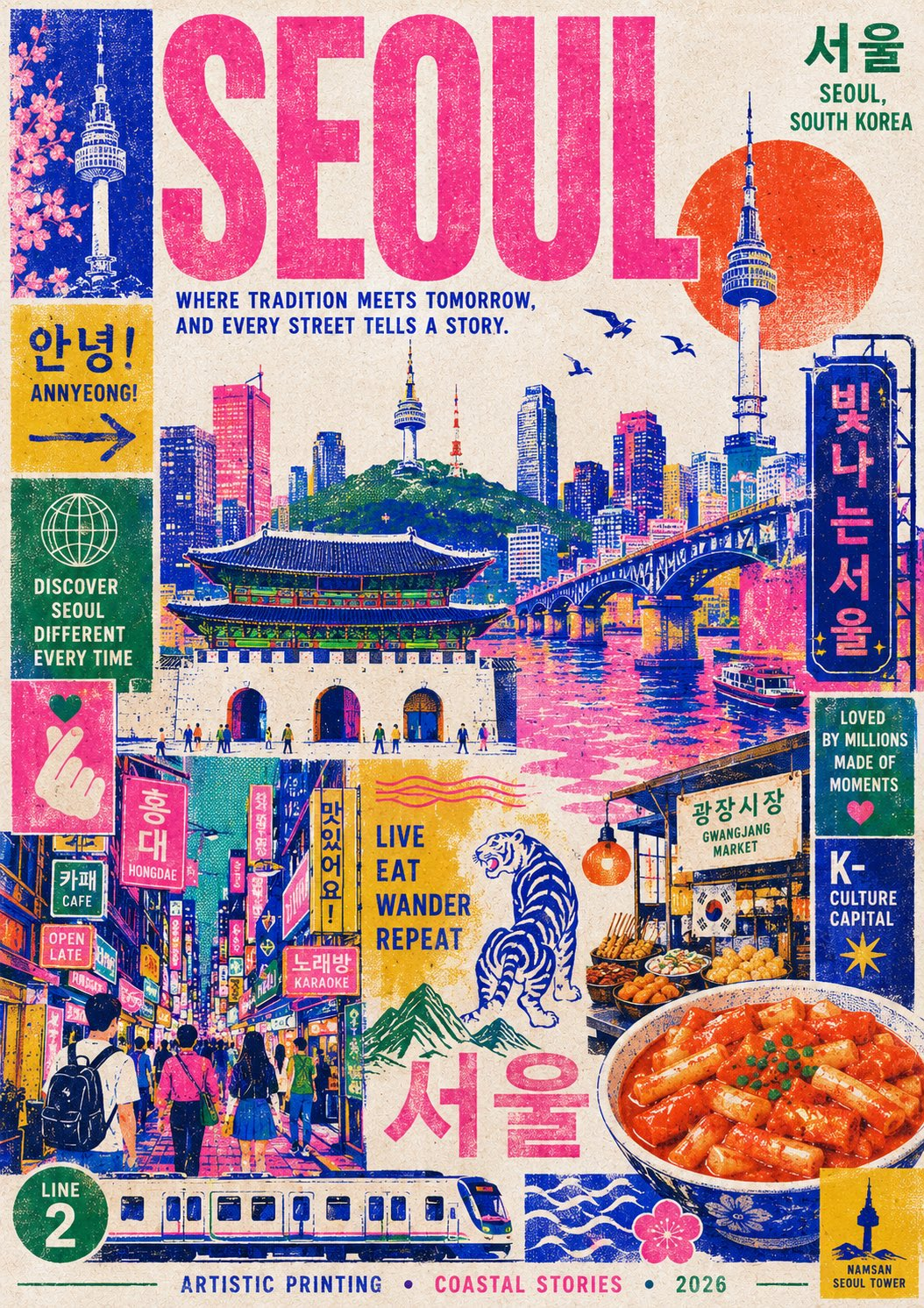
City-campaign teams building local festival posters often need a risograph travel poster prompt that keeps one verified place, its local stories, and its title system coherent instead of turning the page into a generic skyline collage.
Image Examples


Strategic Deployment Guide
Model fit: use an image model that can render dense illustration, legible poster hierarchy, and imperfect print texture. Begin with a verified city brief: one city, three to five landmarks or local motifs, and one short message. This prompt is strongest when the place name, landmarks, subtitle, and footer all describe the same city.
Risograph Travel Poster Prompt Code
Create a stylish modern travel poster inspired by risography about [city]. Use simplified illustrated images of [three to five verified city landmarks], [waterfront, street, market, or cultural motifs], and small abstract decorative figures.

Create a bold, multi-layered risographic poster with imperfect ink, translucent overprints, halftone grain, [paper finish], flat graphic shapes, playful geometry, and an energetic [layout emphasis]. Use [palette] on a white paper background.

Add bold English typography: main title [city title]; subtitle [city-specific story line]; footer [print line and year].

SUBJECT IDENTITY: Make [city identity and cultural lens] unmistakable. The poster must communicate one real place rather than a generic destination, using one consistent local point of view.

SCENE & LOCAL MOTIFS: Add [scene and seasonal moment] only when it supports the selected city. Keep landmark silhouettes, shoreline or transit cues, market details, signs, and decorative figures within one verifiable city story.

VISUAL STRUCTURE: Give the main title the strongest read at thumbnail scale. Place the largest landmark mass in one dominant zone, use smaller motifs as supporting rhythm, and reserve a calm negative-space zone for subtitle and footer. Use overlaps and scale shifts to create a visual path from title to imagery to the footer without crowding the page.

STYLE & MATERIAL: Use [style direction] to keep the print treatment coherent. Allow slight offset, uneven ink coverage, and layered color interaction so the image feels printed rather than digitally airbrushed. Keep foreground and background colors legible after translucent overlaps.

TYPOGRAPHY SYSTEM: Treat the title, subtitle, and footer as part of the poster composition rather than detached labels. Maintain deliberate hierarchy, preserve enough contrast for each line, and keep the footer clean at small size.

OUTPUT FORMAT: [output format: portrait or landscape ratio and print size], with clean borders suitable for an editorial poster, event handout, or campaign proof.

NEGATIVE PROMPT: mixed-city landmarks, incorrect local scripts, generic stock-photo realism, copied poster, artist style, corporate identity, logo, mascot, copyrighted character, exact layout, recognizable commercial design.

Make the design bright, cultural, modern, playful, and collectable, like an original independent risographic poster for a local creative festival. Do not mix landmarks from different cities. Do not copy any existing poster, artist style, corporate identity, logo, mascot, copyrighted character, exact layout, or recognizable commercial design. Create an original composition inspired only by risographic printing methods and modern independent poster design.
Why This Framework Functions
Risograph character comes from constrained color layers, imperfect registration, halftone grain, and paper texture rather than from one named artist. The prompt separates geographic content from the print system: city variables control factual specificity, while the fixed overprint and editorial constraints control the visual language. That split lets the model preserve poster cohesion without blending unrelated landmarks.
Implementation Steps
- Research one place: list only city-specific landmarks, transit, food, waterfront, street, or market details you can verify.
- Choose one hierarchy: decide whether the city title, a landmark, or a market/waterfront scene is the dominant block before generating.
- Fill every variable: replace city, landmarks, motifs, title, subtitle, footer, palette, paper finish, layout emphasis, and output ratio rather than leaving conflicting example text in the prompt.
- Generate a small set: compare layout and type hierarchy, then keep the version with the clearest city read at thumbnail scale.
- Proof the final file: perform print calibration with a two-color separation preview or a small print proof, check title contrast and overprint density, then run the factual city QA before export.
Application Scenarios
- Tourism campaign designers: make a collectible city poster with a date line and neighborhood cues.
- Independent travel publishers: create a guide cover or section opener that routes readers into one verified location.
- Hotel brand teams: develop an original event visual without borrowing a destination brand identity.
- Magazine art directors: pair a city story with a graphic print that foregrounds verified local details.
Why This Prompt Works
The code gives the model both a content ledger and a controlled print recipe. Landmark and motif variables provide location-specific subject matter; the title, subtitle, and footer create a deliberate typography hierarchy; translucent ink layers, halftones, rough paper, and flat shapes unify the separate elements. The original-composition constraint is essential: it asks for print-process cues, not a replica of any existing poster or artist.
Troubleshooting & Optimization
- Mixed locations: replace the landmark field with a verified three-item city list and append:
do not include landmarks, scripts, transit, or food from another city. - Too polished or photographic: append:
flat illustration, imperfect ink registration, visible halftone grain, rough uncoated paper. - Unreadable title: reduce decorative motifs around the upper third and append:
one oversized title block with high contrast and clear letter spacing. - Generic tourism look: swap vague adjectives for one local market, transit, water, night, or neighborhood cue and keep the rest of the palette fixed.
FAQ
- Q: What is a risograph travel poster prompt used for?
A: It turns a verified city brief into an original layered editorial poster with title, local motifs, print texture, and a clear place-specific hierarchy. - Q: How do I stop the image from mixing city landmarks?
A: Fill the landmark and motif variables with a short verified list for one city, then retain the explicit no-cross-city quality check. - Q: Can I change the color palette?
A: Yes. Keep a small high-contrast ink palette and white-paper background so translucent overprints and halftone texture remain legible. - Q: What should I do if the type is unreadable?
A: Reduce the number of motifs near the title, specify one oversized title block, and regenerate rather than adding more text.
Use this prompt as an image-making system: adapt the city variables, verify every local reference, and keep the risograph texture and original-composition safeguards intact.
Explore more visual systems in Image & Design and browse related creative assets in Marketing & Growth.
Share your city-specific variation in the comments, and follow @bigprompt for more reusable prompt systems and visual workflows.
Related Big Prompt Hub pages:
Educational Infographic Prompt: Encyclopedia-Style Science Pages
Animation Character Sheet Prompt: Production Model-Sheet Format
3D Cartoon Sticker Pack Prompt for Expressive Character Sheets
Modern House Miniature Infographic Prompt for Blueprint Panels
Matchday Football Poster Prompts Built Around Match Atmosphere
Big Prompt Hub Review
This asset is valuable when a poster needs to feel city-specific without becoming a random collage. Its strongest control is the separation between local facts and a fixed print language. Human review still matters: verify place names and cultural cues, reject cross-city combinations, and do not use the print brief to imitate a living artist or a recognizable commercial poster.