
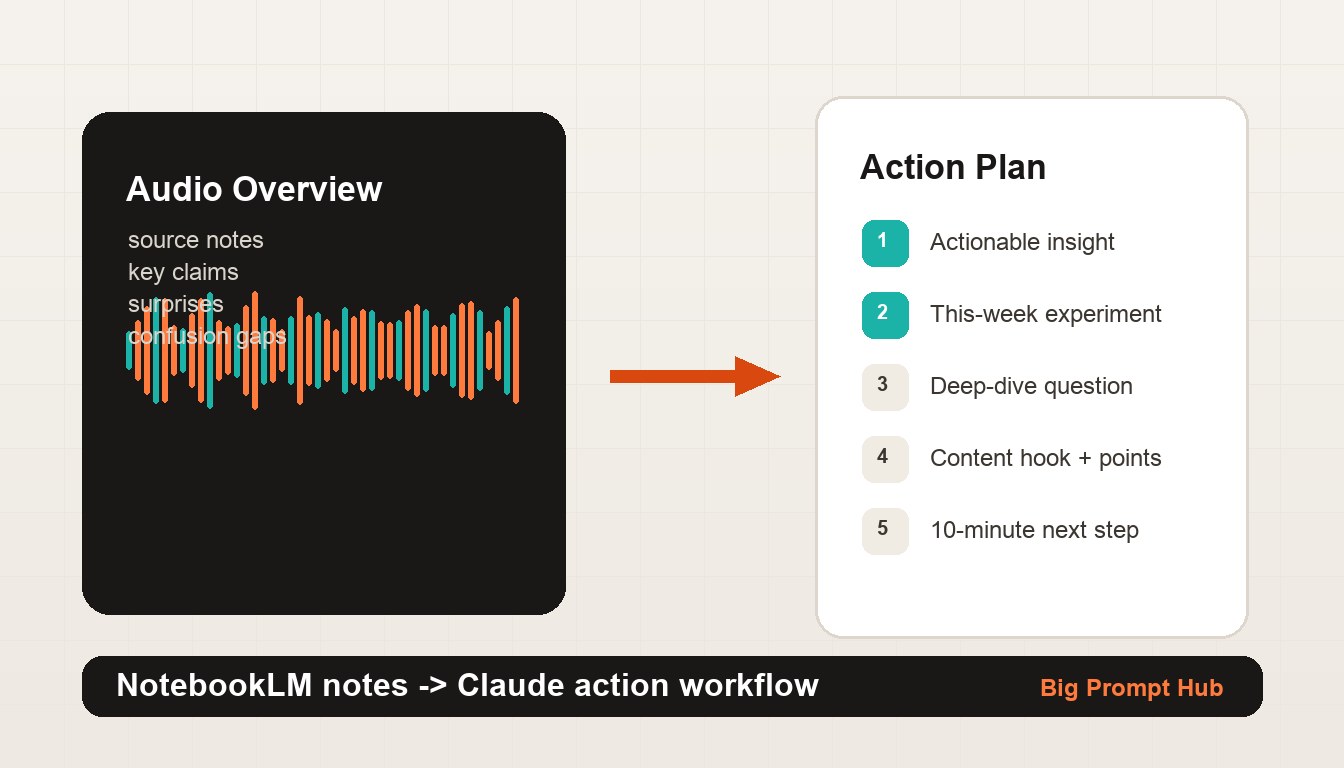
NotebookLM Claude prompts help you use NotebookLM for grounded source summaries and Claude for judgment, synthesis, and decisions. Use this workflow when you have PDFs, podcasts, reports, or notes in NotebookLM and need Claude to turn the material into a thesis, briefing, source audit, learning plan, or weekly knowledge review.
Workflow Overview
Use NotebookLM as the place where sources live. Use Claude after NotebookLM has produced summaries, extracts, citations, or an audio overview. This keeps the work grounded while giving Claude enough context to reason about tradeoffs, weak evidence, and next actions.
- Prompt 1: Find the real question after NotebookLM ingests the source library.
- Prompt 2: Build a thesis you can defend in a meeting.
- Prompt 3: Extract reusable mental models instead of loose facts.
- Prompt 4: Turn industry reports and podcasts into a briefing.
- Prompt 5: Convert a NotebookLM audio overview into action.
- Prompt 6: Build a 30-day domain expertise plan.
- Prompt 7: Check research sources for bias and weak evidence.
- Prompt 8: Run a weekly knowledge audit.
Prompt 1: Real Question Analysis
Target: Use this first when NotebookLM has summarized a source library but the actual decision still feels fuzzy.
- Input: NotebookLM summaries, extracted notes, what decision you need to make, what you already know, and the deadline.
- Model fit: Claude is the better second step because this prompt asks for judgment, contradictions, and synthesis rather than retrieval.
- Expected output: A clear research question, the hidden argument across sources, the missing evidence, and one next question to investigate.
- Quality check: The answer should change what you do next, not simply restate what NotebookLM already summarized.
Prompt Code 1
I just used NotebookLM to extract the following from [x sources]: [NotebookLM summaries, key points, or extracts]

Context for what I am trying to figure out:
- The decision I am trying to make: [decision]
- What I already know: [known facts]
- What I am trying to learn: [question]
- The deadline pressure: [timeline]

Now do what NotebookLM cannot: think with me.

1. The 3 most important insights buried in these extracts, not topics
2. The argument these sources are collectively making, even if no single one states it
3. The contradictions across sources I should resolve
4. The blind spot: what is missing from this research that I should look for next
5. The 1 insight that changes my decision
6. The 3-sentence synthesis I could share with a smart stakeholder
7. The single follow-up question worth ingesting into NotebookLM next

NotebookLM gave me the library. Now help me think.
Prompt 2: Defensible Research Thesis
Target: Use this when your notes are scattered and you need a position that can survive questions from a client, founder, or leadership team.
- Input: Key extracts from NotebookLM, your current hypothesis, and the decision the research is meant to support.
- Model fit: Claude is useful here because the task asks for evidence, counter-evidence, confidence, and executive framing.
- Expected output: One thesis, supporting evidence, the strongest objection, a response to the objection, and a CEO-ready summary.
- Quality check: A good answer should make the uncertainty visible instead of pretending the research proves everything.
Prompt Code 2
Act as a senior strategy consultant who builds defensible theses from messy research.

Here is what I extracted from NotebookLM across [x sources]: [key extracts]

My working hypothesis: [current hypothesis]
The decision this supports: [decision]

Build me a research thesis:

1. The core thesis in one defensible sentence
2. The 3 strongest pieces of evidence for it
3. The 2 strongest pieces of evidence against it, steelmanned
4. The argument a smart skeptic would make
5. My response to that skeptic
6. The confidence level I should hold this thesis with: 60%, 80%, or 95%
7. The data point I would need to flip my position
8. A 3-paragraph executive summary I could send to a CEO

Do not make me sound certain. Make me sound right.
Prompt 3: Mental Model Extraction
Target: Use this when you want reusable thinking tools from a book, report, or paper, not just a summary you will forget next week.
- Input: The source name and the summary NotebookLM produced after ingesting the material.
- Model fit: Claude is strong for abstraction, analogy, and turning source material into a framework you can reuse.
- Expected output: A core mental model, a 3-5 step framework, when it works, when it fails, and one practical use case.
- Quality check: You should be able to apply the model to a different project without rereading the source.
Prompt Code 3
You are a mental model curator who has read 1,000+ business, science, and strategy books and extracted the underlying frameworks from each.

I just ingested [book, report, or paper name] into NotebookLM.
Here is the summary NotebookLM produced: [summary]

Extract the deep structure:

1. The 1 core mental model the author is teaching, even if they never name it
2. The 3-5 step framework hidden inside the work
3. The contrarian belief at the heart of it
4. The conditions under which this model works and when it does not
5. The other books or thinkers who share this model without saying so
6. How I could apply this model this week in my work
7. A 1-sentence use-case cheat sheet I can reference forever

Facts fade. Mental models compound. Show me the compounding asset.
Prompt 4: Meeting-Ready Briefing
Target: Use this before a client meeting, board discussion, expert interview, sales call, or market review where you need to sound prepared quickly.
- Input: NotebookLM summaries and key extracts about an industry, company, topic, or client category.
- Model fit: Claude can translate source material into executive language, likely questions, contrarian views, and memorable phrasing.
- Expected output: A short briefing with key players, trends, insider questions, answers, and a four-sentence summary.
- Quality check: If the briefing still sounds like a generic industry overview, paste sharper source extracts and ask for meeting-specific risks.
Prompt Code 4
Act as a senior chief of staff who briefs executives before they walk into any meeting.

Here is the research I ingested into NotebookLM about [industry, company, or topic]: [summaries and key extracts]

Build me a meeting-ready briefing:

1. The 3 things I must know about this industry to sound credible
2. The 5 key players and their positions
3. The biggest trend nobody is talking about loudly enough
4. The 2-3 contrarian views worth raising
5. The 3 questions a smart insider would ask me to test my knowledge
6. My answers to those 3 questions
7. The 1 phrase or term I should drop in the meeting to signal real understanding
8. A 4-sentence executive summary I could recite from memory

Do not summarize. Brief me like I am walking into a boardroom tomorrow.
Prompt 5: Audio Overview to Action Plan
Target: Use this after listening to a NotebookLM audio overview, especially when the conversation sounded useful but did not yet create an action.
- Input: The audio overview topic, source set, key points, surprising ideas, and remaining confusion.
- Model fit: Claude is useful after the audio because it can turn listening notes into experiments, questions, content angles, and next actions.
- Expected output: One actionable insight, one experiment, one follow-up research question, one content angle, and one 10-minute action.
- Quality check: The output should create a calendar action, a research question, or a draftable idea; otherwise it is still passive consumption.
Prompt Code 5
I just listened to a NotebookLM audio overview on [topic] generated from [sources].

The key points it covered: [key points]
What I found most interesting: [2-3 interesting things]
What surprised me: [surprise]
Where I still feel confused: [confusion]

Now help me use this information:

1. The single most actionable insight from this audio
2. A specific experiment I can run this week to test it
3. The follow-up question worth deep-diving next
4. A short piece of content I could publish based on what I learned, including one hook and three supporting points
5. The mental model embedded in this material that I should remember forever
6. How this changes, if at all, what I am currently working on
7. A 10-minute action I can take right now

Listening without action is consumption. Help me convert it.
Prompt 6: 30-Day Domain Expertise Plan
Target: Use this when you need to learn a market, technical area, client category, or unfamiliar field quickly without pretending one summary makes you an expert.
- Input: The field, your current background, why you need to learn it, weekly time available, and target depth.
- Model fit: Claude acts as the tutor and curriculum designer; NotebookLM becomes the source library for the documents it recommends.
- Expected output: A 30-day learning plan with source recommendations, weekly synthesis tasks, Claude prompts, tests, and a final framework.
- Quality check: The plan should include what to read, what to synthesize, and how to test yourself each week.
Prompt Code 6
You are a senior expert in [field] designing a 30-day deep-dive learning plan for me.

My background: [what I already know]
Why I want to learn this: [reason]
Hours per week I can commit: [hours]
The depth I need: [surface literacy, working knowledge, or expert level]

Design my 30-day expertise plan:

1. The 10 foundational documents I should ingest into NotebookLM, including books, papers, reports, and talks
2. The 5 leading thinkers in this field whose work I must study
3. A weekly reading and synthesis schedule
4. Specific Claude prompts to run after each ingestion session
5. The 3 concepts I should master before moving on
6. A knowledge test I can ask Claude at the end of each week
7. A signature insight or framework I should have formed by Day 30

NotebookLM is the library. Claude is the tutor. Build me the curriculum.
Prompt 7: Bias and Source Check
Target: Use this before you rely on a report, podcast, book, or article as evidence. NotebookLM can ingest weak sources too; this prompt forces a second look.
- Input: A NotebookLM summary or key claims, the source type, and the author or organization behind it.
- Model fit: Claude works as a research methodologist here, looking for bias, missing evidence, weak claims, and better sources.
- Expected output: A bias diagnosis, weak and strong claims, omissions, methodology issues, follow-up sources, and a trust rating.
- Quality check: The answer should make you less likely to over-trust one polished source.
Prompt Code 7
Act as a research methodologist who teaches graduate students how to identify bias, weak evidence, and BS in any source.

Here is a source I extracted via NotebookLM: [summary or key claims]
Original source type: [book, study, article, podcast, or report]
Author or organization: [name]

Run a critical analysis:

1. The author's likely bias: institutional, ideological, financial, or methodological
2. The strongest claim: is the evidence actually strong, or just confidently stated?
3. The weakest claim: what evidence is missing?
4. The convenient omissions: what would contradict their thesis that they did not include?
5. The methodology issues, including sample size, selection bias, recency, or other limitations
6. The 3 follow-up sources I should read to triangulate
7. A confidence rating from 1-10 on how much I should trust this source

Most research mistakes come from over-trusting one source. Help me triangulate.
Prompt 8: Weekly Knowledge Audit
Target: Use this at the end of the week when you have consumed a lot of material and need to know what actually changed your thinking.
- Input: The sources you put into NotebookLM, time spent, decisions supported, insights, forgotten material, and avoided topics.
- Model fit: Claude is useful as a personal research strategist because the task asks for judgment about learning quality, not another summary.
- Expected output: The one idea worth remembering, wasted content, places where you consumed instead of thought, and the next topic to ingest.
- Quality check: A strong audit should change next week’s reading list or work priorities.
Prompt Code 8
Act as my personal research strategist running my weekly knowledge audit.

This week's inputs:
- Sources I ingested into NotebookLM: [source list]
- Hours spent consuming content: [hours]
- Decisions or projects this research supports: [decisions or projects]
- Insights I am proud of: [insights]
- Things I read but already forgot: [forgotten items]
- Topics I am avoiding learning about: [avoided topics]

Run my full weekly knowledge audit:

1. The 1 insight from this week worth remembering 6 months from now
2. The 1 piece of content that was not worth the time
3. Where I am consuming instead of thinking
4. Where I am thinking but not acting on what I learned
5. The knowledge debt: topics I keep meaning to dive into but have not
6. The single follow-up topic worth ingesting next week
7. A letter from my smarter self 6 months from now: what would I want me to prioritize learning?

Most people read more. The pros synthesize more. Show me the difference.
How to Use This Research Workflow
- For a fast research project: Use the NotebookLM Claude prompts in Prompt 1, Prompt 2, Prompt 4, and Prompt 7.
- For a new field: Start with Prompt 6, then use Prompt 3 after each major source.
- For audio overviews: Use Prompt 5 immediately after listening, before the useful idea fades.
- For a weekly habit: Use Prompt 8 every Friday or Sunday to decide what deserves attention next week.
Workflow Use Cases
- Consulting and client discovery: Use NotebookLM Claude prompts to turn reports, podcast transcripts, and market notes into a brief you can use in a meeting.
- Founder market research: Move from scattered source notes to a thesis, a risk list, and a next research question.
- Content strategy: Use NotebookLM for source grounding, then ask Claude for angles, mental models, and useful public explanations.
- Learning sprints: Build a 30-day plan, test yourself weekly, and avoid mistaking content consumption for expertise.
Failure Points & Fixes
- The answer sounds generic: Paste more specific NotebookLM extracts, not just the topic name.
- Claude overstates certainty: Ask for evidence against the thesis, a confidence level, and what would change the conclusion.
- The briefing is too broad: Add the meeting audience, decision, industry, and what you need to sound prepared for.
- You keep consuming more sources: Use Prompt 8 before adding another report to the pile.
NotebookLM Claude Prompts FAQ
- Q: How do I use NotebookLM and Claude together for research?
A: Put the source material into NotebookLM first, then copy summaries, extracts, citations, or audio overview notes into Claude. NotebookLM gives the grounded material; Claude turns it into decisions, arguments, briefs, checks, and next steps.
- Q: What should I paste from NotebookLM into Claude?
A: Paste the specific summaries, claims, contradictions, citations, and questions that matter to your decision. Avoid pasting only a topic name. These NotebookLM Claude prompts work better when Claude can see the evidence you want it to reason about.
- Q: Should I use all eight prompts every time?
A: No. Use Prompt 1-4 for a research brief, Prompt 5 for NotebookLM audio overviews, Prompt 6 for a learning plan, Prompt 7 for source criticism, and Prompt 8 for weekly review. Use all eight only for a larger industry or client research sprint.
- Q: Can ChatGPT replace Claude in this workflow?
A: Yes. Claude is often strong for long synthesis and reflective reasoning, but ChatGPT can also handle the workflow if you provide enough NotebookLM source material and ask for evidence, caveats, and next actions.
- Q: Are these prompts only for consultants?
A: No. They are useful for founders, analysts, writers, students, researchers, and operators who need to turn a source library into a usable decision, briefing, learning plan, or content angle.
Use this prompt pack to generate your version? Share in the comments or on Twitter!
Explore more? View the Business & Productivity or Writing & Content Creation category.
I hope you found this NotebookLM Claude research workflow AI prompt pack helpful.
Follow me @bigprompt for more.
Like/Repost if this prompt pack is useful.
Internal link:
Create Luxury Home Renders with AI Architectural Rendering Prompt
Scale Product Launches via Premium Blind Box Packaging Prompt
Craft Trendy Instagram Layouts via Social Media Graphic Design Prompt
Scale Commercial Campaigns via Premium Social Media Ad Prompt
Generate Premium Editorial Layouts via Minimalist Product Photo Prompt
Big Prompt Hub Review
This prompt pack is valuable because it does not ask one model to do everything. NotebookLM keeps the work tied to actual sources, while Claude handles judgment, framing, critique, and synthesis. The strongest use case is client or market research: Prompt 1 finds the real question, Prompt 2 forms a defensible thesis, Prompt 4 turns the work into a briefing, and Prompt 7 keeps the evidence honest. The main limitation is input quality. If the NotebookLM extracts are vague, Claude will still produce a polished but weak answer.