
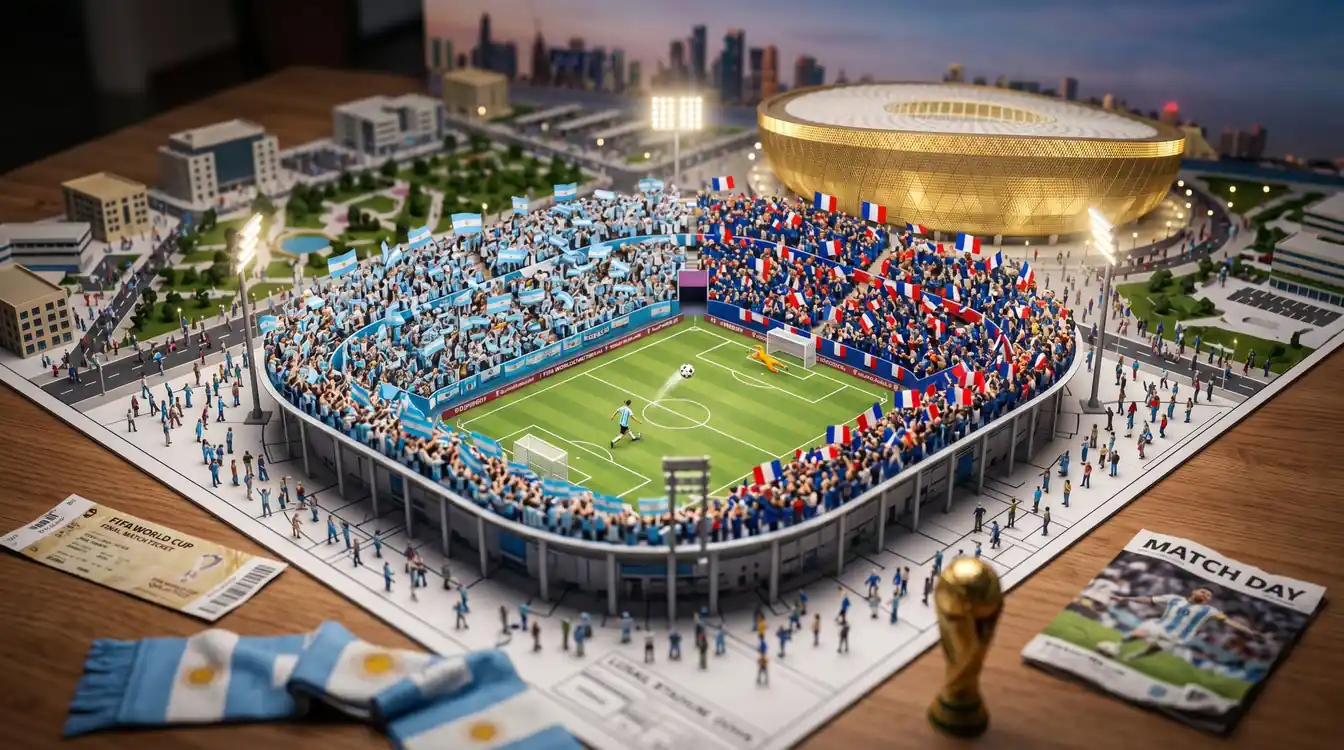
Club marketers and tournament creatives can use a football stadium map diorama prompt to turn one venue blueprint into a live miniature match world with supporters, city detail, and one decisive football moment locked at the center. Editorial sports designers can use the same structure to pitch match-day key art that feels collectible instead of generic stadium hype.
Image Examples


Strategic Deployment Guide
Model fit: Adobe Firefly Boards is the closest starting point because the source prompt depends on tight miniature staging, evening stadium glow, and layered city context around one venue blueprint. ChatGPT or Gemini can help with alternate matchups, but whichever model you use, keep post-render cleanup reserved for tickets, banners, and tiny map text.
Football Stadium Map Diorama Prompt Code
CORE SCENE:
A football stadium map of [stadium], [city] spread across a table, transformed into a living miniature world. Match day erupts from the blueprint as [team] faces [opponent] in [tournament].

VENUE IDENTITY CONTROL:
The venue must read as [stadium] in [city], not as a generic football bowl. Preserve stadium-specific architecture, roofline or facade cues, surrounding road or skyline hints, and supporter atmosphere tied to that place. Keep the crowd, scarves, flags, and banners aligned to [team] and [opponent].

MATCH MOMENT LOGIC:
Players are frozen in the defining moment of the match: [match moment]. The ball should feel suspended at the exact second when history is about to change. Choose one clear football action rather than a vague celebration cloud.

LAYOUT AND COMPOSITION:
Let the pitch rise from the map surface as the center of the composition. Keep the folded paper base, blueprint lines, and tabletop context visible. Arrange the stadium bowl as the hero, then let the surrounding city emerge around it in miniature so the scene feels engineered from the map rather than pasted on top of it.

CROWD, CITY, AND TABLETOP DETAIL:
Fill the stands with thousands of tiny supporters, waving flags, scarves, and banners in team colors. Around the stadium, show fans streaming toward the ground from every direction. Place match tickets, supporter scarves, and football memorabilia beside the map so they act like portals into the diorama. Stadium floodlights should glow into the evening sky and give the crowd energy a visible pulse.

STYLE AND MATERIAL DIRECTION:
Championship atmosphere, football passion, ultra-detailed miniature world, cinematic lighting, tilt-shift photography, photorealistic details, emotional storytelling, realistic paper-map texture, shallow depth of field, premium sports-art finish, 8K masterpiece.

NEGATIVE PROMPT:
Avoid generic aerial renders, empty stands, mixed stadium architecture, wrong team colors, unreadable scoreboards, random sponsor logos, flat city surroundings, malformed players, messy memorabilia piles, and overblown fireworks that hide the stadium map.

PRODUCTION FORMAT:
16:9 widescreen cinematic sports visual, commercial presentation quality, high-resolution render, readable negative space around the stadium map, clear hero moment, and print-ready scene detail.

SCENE TRANSLATION LOGIC:
When you swap [stadium], [city], [team], [opponent], [tournament], and [match moment], keep the same tabletop blueprint-to-diorama mechanic, venue-specific identity, crowd scale, and one decisive football action. Do not add extra location variables, camera systems, or style families beyond the original source structure.
Why This Framework Functions
This framework works because it stacks four controls in the right order. The blueprint map stabilizes composition, the stadium identity anchors place, the match moment concentrates emotion, and the crowd-plus-city ring sells scale. If any one of those disappears, the image slips into generic football wallpaper. When all four stay visible, the render reads like a collectible event object with narrative tension already built in.
Implementation Steps
- Lock the six source variables first: Set [stadium], [city], [team], [opponent], [tournament], and [match moment] before you touch style language.
- Keep the map readable: The folded blueprint base has to stay visible around the stadium. If the pitch or skyline swallows the paper edge, reduce density and rerun.
- Choose one football action, not three: A penalty, bicycle kick, volley, or breakaway reads better than trying to stage multiple moments in one miniature scene.
- Verify venue identity on the second pass: Check the roofline, facade, and city context against the real venue. If the model drifts, tighten the stadium wording rather than adding more hype adjectives.
- Finish with post-render cleanup: Rebuild ticket text, scarf lettering, and any tiny labels in Photoshop or Figma after generation. The scene is the hero; microtype should stay editable.
Application Scenarios
- Tournament campaign decks: Match-day hero visuals for sponsors, broadcasters, and federation creative reviews.
- Club social launches: Key art for marquee fixtures, rivalry build-up posts, and premium countdown assets.
- Sports editorial covers: Feature illustrations for finals previews, rivalry stories, and football culture newsletters.
- Agency moodboards: Commercial concept art for match promotions, brand activations, and hospitality event collateral.
Why This Prompt Works
This prompt works because it gives the model a clear physical metaphor instead of loose sports spectacle. The stadium is not floating in abstract smoke; it is emerging from a printed map on a table, which automatically creates hierarchy, scale, and story. That physical constraint also makes variable swaps more reliable. You can move from a World Cup final to El Clásico or a Champions League night without rebuilding the whole composition system from scratch.
Troubleshooting & Optimization
- Scene feels like a generic aerial stadium: Append spread across a table, transformed from a folded blueprint into a miniature world.
- The venue is not recognizable: Append stadium-specific architecture, roofline cues, and surrounding city identity tied to [stadium] in [city].
- The match moment lacks drama: Replace [match moment] with one exact football action such as winning penalty in a shootout or last-second bicycle kick into the top corner.
- Crowd scale is too weak: Append thousands of tiny supporters filling every stand, fans streaming toward the ground from every direction.
- Tickets and banners break down: Keep them minimal in-prompt, then rebuild the final microtext manually after render instead of forcing legible tiny typography out of the model.
FAQ
- Q: What is a football stadium map diorama prompt used for?
A: It is used to turn a specific football venue into a tabletop match-day miniature, combining stadium architecture, city context, crowd atmosphere, and one decisive action in a single sports visual. - Q: How do I keep the stadium recognizable after swapping teams or tournaments?
A: Keep the venue and city fixed first, then change only the match variables. The roofline, facade, skyline hints, and supporter culture are what stop the image from collapsing into a generic ground. - Q: Can the same structure work for club matches and national-team matches?
A: Yes. The composition system stays the same. What changes are the color logic, the memorabilia around the map, and the match action you choose to freeze.
Use this prompt to generate your version? Share in the comments or on Twitter!
Explore more? View the Image & Design or Fun & Creative category.
I hope you found this football match-day AI prompt helpful.
Follow me @bigprompt for more.
Like/Repost if you can this prompt.
Internal link:
Pop-Up Map Diorama Prompt for Folded Travel Worlds
Football Collectible Diorama Prompt for Museum-Style Player Boxes
World Cup Prompt Pack for Trophy Ads, Team Posters, and Match-Day Graphics
A World Cup Trophy Prompt for Country Football Ads
Lock Sharp Edge Shadows with Landmark Papercraft Poster Prompt
Big Prompt Hub Review
This page is strongest when you need football event art that still has a physical object logic behind it. The map base, venue identity, and frozen match action give the model a more disciplined job than generic stadium spectacle prompts. The main limitation is micro-detail reliability: tiny banners, tickets, and labels still need human cleanup, and venue recognition can drift if the stadium wording is too loose. Use it for campaign concepts, editorial sports art, and premium match-night moodboards first, then polish the small text by hand.