
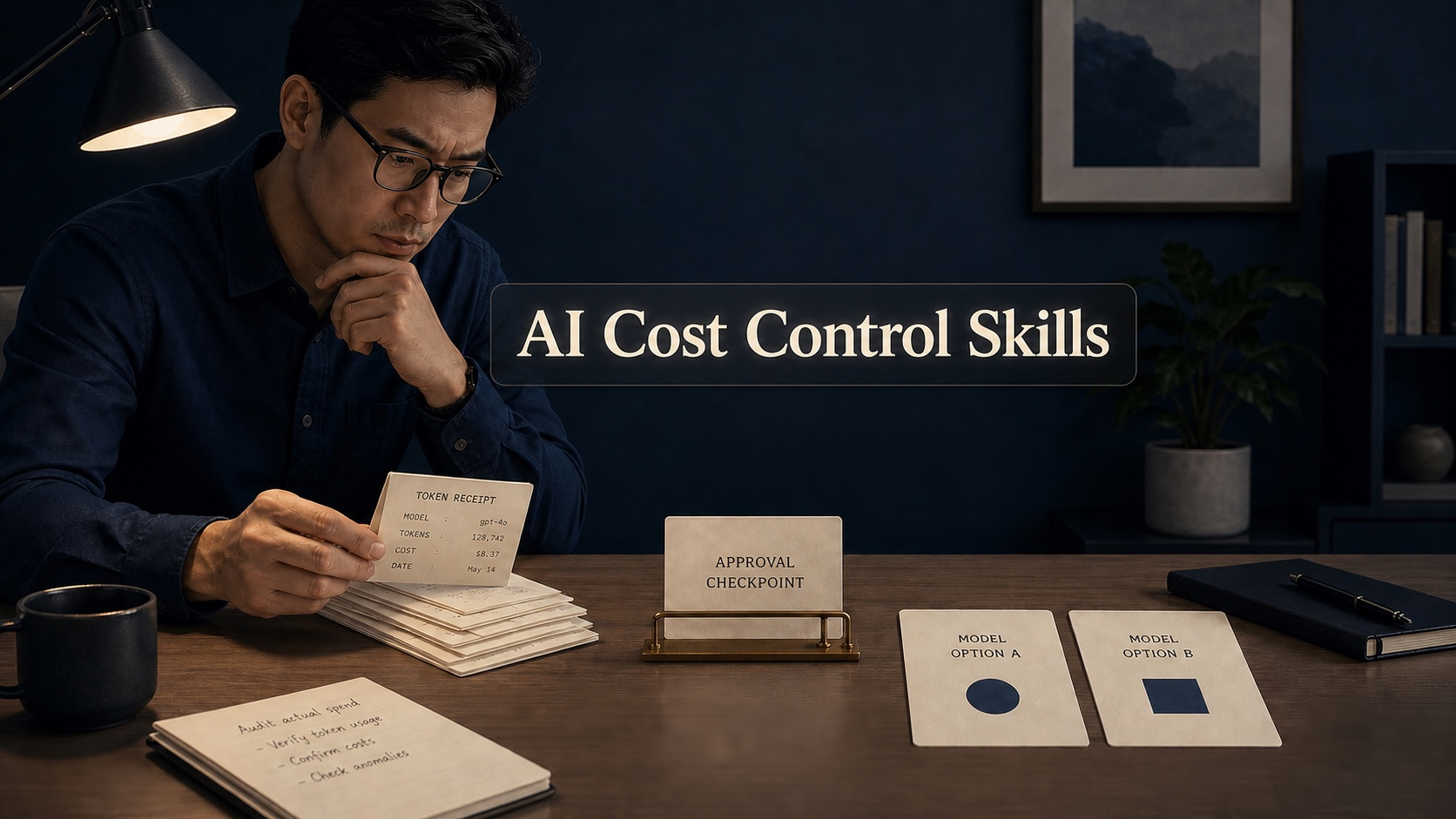
AI cost control skills help engineering and AI-operations teams inspect real token receipts, set guarded model routes, and compare cost per finished task before changing a production default. This collection is for teams that need evidence about their own workload, not a promise of automatic savings.
Skills Overview
The ai-cost-cutter-skills repository is a ten-skill collection for cost governance in agents. It groups model routing, token visibility, context reduction, model selection, fallback rehearsal, and free-tier batch planning into separate, documented skills.
Where This Skill Collection Fits
Use it after a team has a real usage export or representative tasks to inspect. Start with receipts before changing routes: a low token share can still be a high dollar share, and a cheaper model only helps if task quality remains acceptable.
Who It Helps
- AI platform engineers: need a documented escalation gate rather than an across-the-board model downgrade.
- Agent operations teams: need to separate usage evidence, routing rules, and fallback testing.
- Technical finance owners: need cost-per-finished-task evidence before treating a change as a saving.
Access / Install Links
The repository documents installation with the skills CLI and a Claude Code plugin route. The source also names Codex, Cursor, and agents that read the agentskills.io SKILL.md format as supported environments.
Skills Included
Routing controls. Use route-cheap-escalate-hard for a cheap default plus written escalation gate; advisor-call-budget for premium advisor caps; and cheap-swap-guard when evidence says a lower-cost model loses on specific cases.
Usage and context controls. token-receipts-audit compares token share with dollar share; context-diet checks a queryable index against repeated context loading; reasoning-effort-throttle documents a modest default and explicit escalation conditions.
Selection and resilience evidence. model-bakeoff compares real prompts against a declared scoring rule, while tested-fallback records an open-weights fallback, a test date, and smoke prompts.
Free-tier operations. free-tier-batch-plan calculates budget fit and ETA before a large run; free-model-triage keeps low-stakes reading within a strict response schema.
Selection Logic
- When the bill is unclear, begin with token-receipts-audit.
- When an expensive route is known, choose a routing control only after defining the task gate and quality check.
- When model choice is disputed, use model-bakeoff on real prompts before moving traffic.
- When reliability is the concern, rehearse tested-fallback instead of assuming an untested backup will work.
Setup Steps
- Preview the inventory, then install only the skill that matches the current cost question.
- Collect a bounded usage export or representative task set, plus current unit prices and an acceptance rule.
- Run the skill’s proof block or a small real workload test; keep quality evidence beside the cost calculation.
- Record the result as a route, threshold, fallback, or batch boundary—not as a universal provider claim.
Example Inputs
01 · Preview the collection
Use when: You need to confirm the available skills before installing.
npx skills add Neeeophytee/ai-cost-cutter-skills --listExpected output: The source-defined skill inventory for a scoped installation decision.
02 · Install token receipt audit
Use when: A usage export needs a token-share and dollar-share audit.
npx skills add Neeeophytee/ai-cost-cutter-skills --skill token-receipts-auditExpected output: One named skill, ready to guide a bounded receipt audit.
Expected Outputs
- Receipt audit: per-tier token share, dollar share, and a routing interpretation.
- Routing evidence: a cheap/premium condition, advisor cap, or protected premium case.
- Operational boundary: a before/after context comparison, fallback rehearsal, or free-tier batch ETA.
Use Cases
- Agent release review: audit a weekly usage export before changing a default model.
- Support triage queue: route low-stakes reading to a free model only with a fixed one-line schema.
- Large offline job: calculate a free-tier batch’s token fit and ETA before scheduling it.
Common Mistakes & Fixes
- Calling a benchmark a guaranteed saving: measure your own cost per finished task and retain the date of prices and limits.
- Sending every task to a cheap model: write the escalation rule and protected failure cases first.
- Trusting CI as model-quality evidence: CI proves deterministic proof blocks run, not that your production workload is better.
Limitations
Provider prices, rate limits, model behavior, and free-tier terms change. The repository’s verification workflow checks its deterministic proof blocks on push, pull request, and a weekly schedule, but it does not prove model quality, a reader’s production savings, or cross-agent equivalence. Recheck operational inputs against current provider documentation before acting.
Related Tools / Prompts
For cleaning unused local skills before altering an agent environment, see Deadskills vs Skillreaper. For a production workflow that needs approval rather than automated posting, see URL to Social Content with Human Approval.
AI Cost Control Skills FAQ
- Q: What are AI cost control skills?
A: They are the collection’s ten documented skills for receipt audits, guarded routing, context checks, testing, fallbacks, and free-tier operations. - Q: How should a team start a token audit?
A: Use a real usage export, period, model tiers, and current unit prices; compare both token and dollar share. - Q: Can a routing rule guarantee savings?
A: No. Measure the result on real finished tasks and keep quality gates beside the cost calculation.
Explore AI Skills and Coding & Development for related agent operating patterns. Follow @bigprompt for more reusable skills and workflows.
More ways to make agent operations reviewable
Video Shotcraft for Remotion product-video production shows a skill with source-backed review steps; Gimi 配图 Skill demonstrates how a constrained skill records its visual and IP boundary; Littlebox 插画 Skill is another source-backed installation and output page.
Big Prompt Hub Review
This collection earns attention because it begins with receipts and testable gates instead of headline savings. It is most useful when a team treats each recommendation as a measurement plan: inspect the workload, state the rule, run a bounded proof, and keep the quality result. Start with token receipts before changing a route; delay any broad claim until your own finished-task evidence exists.