
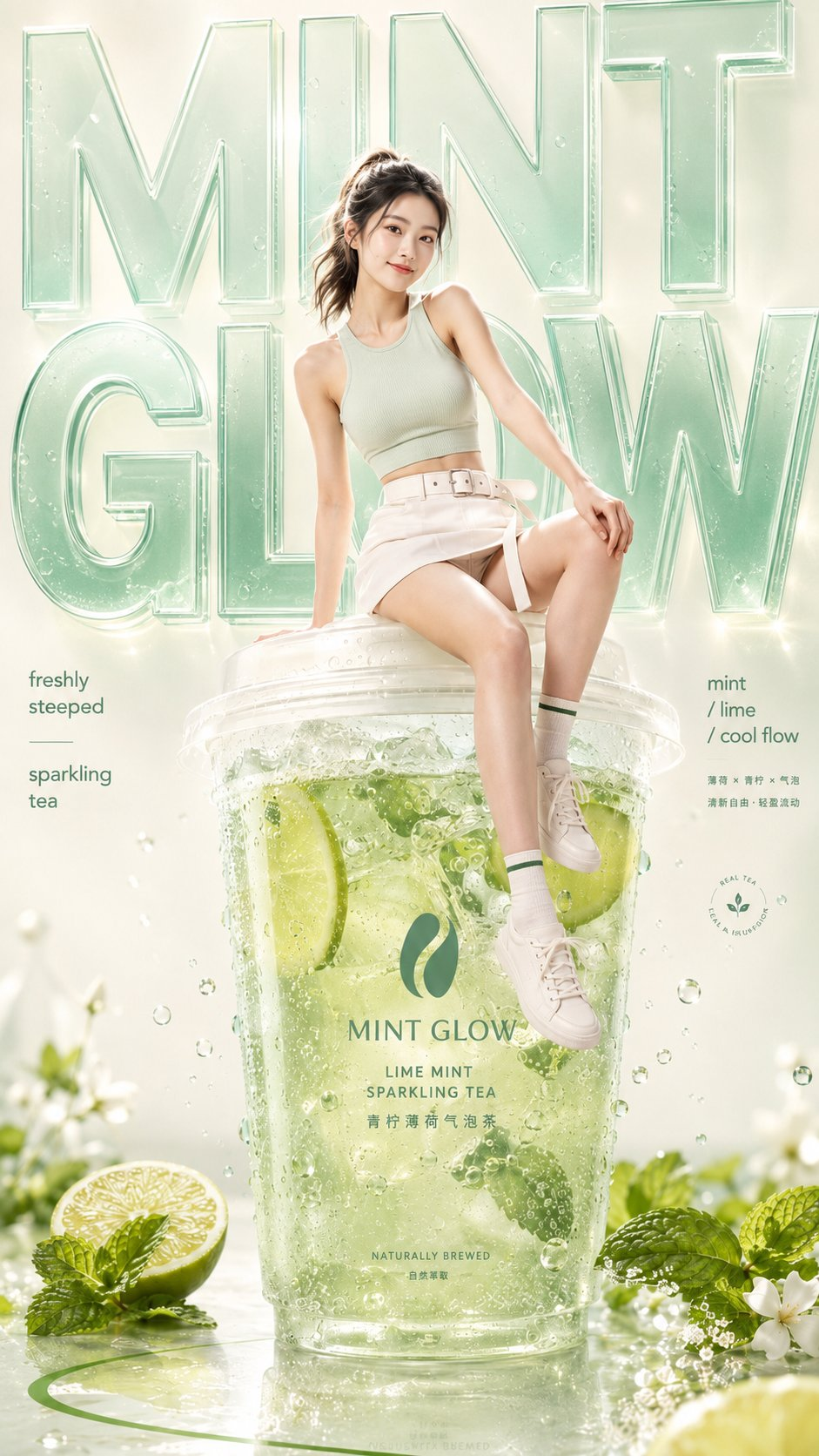
When beverage marketers need launch-ready vertical key art, this oversized product fashion prompt combines giant packaging, a photorealistic model, flavor-led ingredients, and material typography in one reusable brief. The variables keep the brand, product, pose, styling, and atmosphere editable while the visual hierarchy stays consistent across a campaign series.
Image Examples


Strategic Deployment Guide
Model fit: Use Gemini as the primary model because it can follow a long visual brief, preserve photorealistic product-model contact, and integrate headline lettering behind the subjects. Use a second image model only as a fallback when Gemini loses pose contact or packaging geometry, and keep the same variables for a fair comparison. Treat generated packaging claims and small copy as draft artwork until a human reviewer checks spelling, product facts, anatomy, and brand clearance.
Oversized Product Fashion Prompt Code
INPUTS:

[Product type]: {sparkling tea / cold brew / smoothie / dessert drink / other}
[Brand name]: {original fictional brand}
[Product name]: {original product name}
[Flavor]: {fruit, tea, dairy, herbs, or other ingredients}
[Main headline]: {a short original two-word phrase}
[Model]: {young adult woman, appearance, hairstyle, expression}
[Expression]: {bright, confident, playful, calm, or another campaign expression}
[Pose]: {sitting, leaning, crouching, half-standing, or another interaction}
[Outfit]: {youthful fashion styling}
[Camera view]: {eye level / low angle / three-quarter view / slight overhead}
[Color palette]: {main color + neutral color + accent color}
[Decorative ingredients]: {fruit, flowers, herbs, ice, leaves, or food materials}
[Atmosphere]: {sunlight, mist, bubbles, reflections, condensation, or other}
[Package material]: {clear plastic / glass / paper cup / carton / other verified material}
[Headline material]: {translucent glass / jelly / acrylic / condensation / glossy gradient}
[Visual style]: {premium editorial / playful Gen Z / minimal luxury / other art direction}
[Aspect ratio]: 9:16
[Output quality]: {photorealistic commercial key art, high resolution, clean product edges}
[Negative prompt]: {floating pose, broken anatomy, warped packaging, illegible labels, clutter, duplicate ingredients}

STRUCTURE:

Create the final image directly as a premium vertical fashion campaign for an original trendy drink or food brand.

CONTROLS:

Keep the selected model identity, face, hairstyle, and outfit consistent within each campaign variation. Turn the product into an oversized installation occupying around 40–50% of the frame. Use [Camera view]. The young adult model should interact naturally with it by sitting, leaning, stepping, or balancing on the packaging. Show believable weight, contact, perspective, and body proportions. Use [Expression], natural skin texture, realistic hair, and an expressive gaze slightly toward the camera.

Use a different pose for each image so the series does not feel repetitive. Keep the product and model as the clear primary subjects.

Place fruit, flowers, herbs, ice, leaves, or other flavor ingredients around the foreground and lower edges. These elements should enrich the scene but remain secondary, occupying only about 10–15% of the visual attention. Use partial cropping and soft foreground blur to create depth.

Add one oversized two-word headline behind the model and product. Give the typography the selected [Headline material], inspired by the flavor. Let parts of the letters overlap naturally with the model and product to create spatial depth. Render the package with the selected [Package material] and keep its edges physically believable.

Do not use “VOL.1,” “ISSUE 01,” decorative numbering, or generic template labels. Add 3–5 pieces of short original brand copy and arrange them asymmetrically along the frame edge, product contour, light direction, or circular graphic elements.

Use a clean high-key studio environment, a soft color-gradient background, subtle reflective flooring, controlled sunlight, and a product-specific atmospheric effect. Keep the layout rich but uncluttered.

NEGATIVE PROMPT:

Avoid [Negative prompt].

PRODUCTION FORMAT:

Apply [Visual style] with realistic liquid, ice, fruit, condensation, packaging materials, natural skin, accurate hands and feet, strong visual hierarchy, and refined typography. Deliver [Output quality] in [Aspect ratio].
Implementation Steps
- Define one product system: Choose the drink type, fictional brand, product name, flavor, and two-word headline before adding visual styling.
- Direct the interaction: Specify the model, outfit, and a pose that creates believable weight and contact with the oversized package.
- Build flavor cues: Match the palette, decorative ingredients, typography material, and atmosphere to the product rather than mixing unrelated motifs.
- Control the hierarchy: Keep the package and model dominant, ingredients secondary, and edge copy short enough to remain readable in a 9:16 frame.
- Finish with post-processing: Inpaint hands, feet, package edges, and reflections; use typographic masking in Figma or Illustrator to composite approved claims, color-grade the series, upscale the chosen frame, and export a color-managed 9:16 master.
Application Scenarios
- Beverage brand managers: Build seasonal launch posters for summer tea, winter coffee, or limited-edition smoothie flavors.
- Social media teams: Produce 9:16 key art for Instagram Stories, Reels covers, TikTok launch teasers, and retail screens.
- Creative agencies: Deliver client concept boards that compare poses, headline materials, camera views, and flavor palettes.
- Café marketing teams: Create food-fashion collaboration posters for menus, storefront displays, and paid social campaigns.
Why This Prompt Works
The prompt separates editable campaign inputs from fixed composition rules. That lets a team change the flavor, model, outfit, ingredients, and atmosphere without losing the oversized-product idea or the premium editorial hierarchy.
It also assigns visual attention: the package and model lead, ingredients stay supportive, and the headline sits behind both subjects. Those boundaries reduce clutter while preserving enough variation for a multi-image launch.
Troubleshooting & Optimization
- If the model appears to float: append “show compressed contact points, cast shadows, and realistic weight where the model touches the package.”
- If the product looks too small: replace the scale line with “the package fills 45% of the frame and remains larger than the seated model.”
- If ingredients become clutter: append “limit garnish to the lower 15% of the frame with one foreground blur layer.”
- If headline text breaks: generate a clean two-word text area, then rebuild the final lettering in a design tool using the same glass or jelly material direction.
- If the series feels repetitive: change the pose, camera height, package angle, and flavor atmosphere while keeping the brand grid and headline scale consistent.
Drink Campaign FAQ
- Q: What is an oversized product fashion prompt?
A: It is a visual brief that turns packaging into a giant set piece and directs a fashion model to interact with it for a polished advertising image. - Q: Can I use this for food instead of drinks?
A: Yes. Replace the product type, flavor materials, garnish, package form, and headline effect while preserving the scale and interaction rules. - Q: Which parts should stay consistent across a series?
A: Keep the brand identity, headline scale, product dominance, lighting logic, and edge-copy system stable; vary the pose, flavor, palette, and ingredients. - Q: Should generated label text go straight into an ad?
A: No. Rebuild product names, claims, ingredients, and legal copy from approved source files before commercial use.
Use this prompt to generate your version? Share the result in the comments.
Explore more? View Marketing & Growth or Image & Design.
I hope you found this oversized product fashion AI prompt helpful.
Follow @bigprompt for more prompts and workflow systems.
Thermos Bottle Video Prompt for a Product Review
Watercolor Travel Poster Prompt for Architectural Museums
Fruit Beer Poster Prompt for a Premium 4-Panel Campaign
Ice Cream Poster Prompt for a Premium 2×2 Flavor Campaign
AI Home Renovation Prompts and Workflows
Big Prompt Hub Review
This prompt is strongest as a campaign-system brief rather than a one-off image request. Its explicit scale, pose, ingredient, typography, and attention controls make flavor variations easier to art-direct. The main limitation is small generated copy: teams should treat the image as key art, then rebuild labels and claims from approved brand files.