
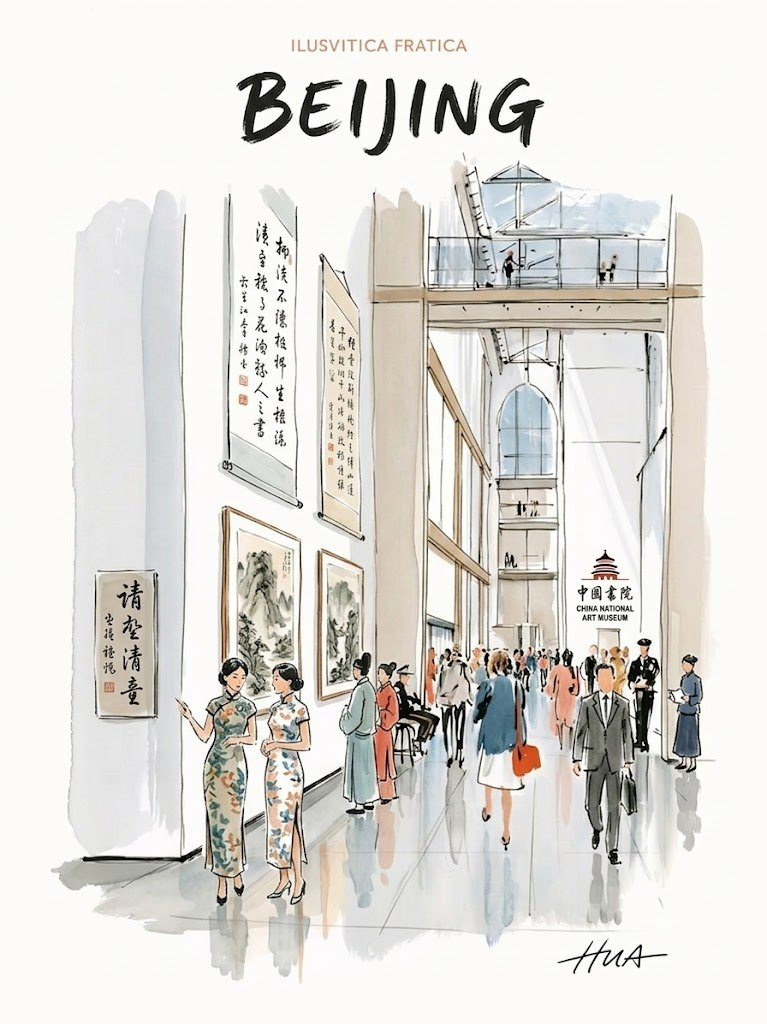
Museum teams, travel illustrators, and destination-marketing designers need a watercolor travel poster prompt that turns a real cultural interior into a reusable vertical destination campaign with controlled architecture, exhibits, people, lettering, and local identity. It gives a creative team a repeatable way to compare cities while keeping cultural references and final typography under human review.
Image Examples


Strategic Deployment Guide
Model fit: Gemini is the primary fit because it can follow long visual instructions, architectural perspective, bilingual text placement, and watercolor material direction in one brief. If Gemini is unavailable, use a fallback image model only when it preserves the same reference and typography controls. Replace the city variables, preserve the high-ceiling interior and poster hierarchy, and render a small typography test before committing to a client-facing destination campaign.
watercolor travel poster prompt Code
CREATE A VERTICAL DESTINATION POSTER:
Create a refined [aspect ratio] travel-poster illustration for [city or location] in a watercolor-and-ink architectural sketch style. Use a spacious modern cultural interior with [ceiling and skylight design], polished reflective floors, and [minimal architecture language]. Keep the central perspective believable: verticals stay aligned, the floor reflection follows the vanishing point, and visitors remain correctly scaled.

CONTROL DIMENSIONS: use [front angle and side view] for the architectural view, [output format and resolution] for delivery, [destination identity] for the page's visual identity, and [visitor pose and expression] for natural human interaction.

LOCAL IDENTITY AND EXHIBITS:
Display [local artworks, artifacts, or cultural exhibits] along the gallery walls. Include visitors in [contemporary and traditional regional attire] interacting naturally with the exhibits. On a clean museum wall, place a minimalist logo inspired by [famous local landmark] and bilingual signage in [language pair]. Keep every cultural reference respectful and verify names, scripts, and landmark forms before publication.

POSTER TYPOGRAPHY:
At the top, set the small subtitle [subtitle] above the main destination name [city name] in bold hand-drawn brush lettering. Give the lettering [typography material effect] inspired by the local atmosphere. Allow the headline to overlap architecture and visitors only where depth remains readable. Add [short supporting copy] as restrained edge annotations; do not add decorative numbering or generic template labels.

PALETTE, LIGHT, AND OUTPUT:
Use [muted earthy palette], soft watercolor washes, delicate ink linework, natural lighting, and [paper and pigment texture]. Keep the composition clean and airy, with a clear hierarchy: destination name, architectural space, exhibits, then people and signage. Output a print-ready high-resolution poster with crisp but human lettering. Preserve the poster's vertical layout, generous negative space, and watercolor paper grain through the final export.

NEGATIVE CONSTRAINTS:
No generic city skyline, random monument, invented museum name, unreadable bilingual text, misspelled destination, warped perspective, floating visitors, repeated faces, plastic-looking watercolor, photorealistic CGI, dense collage, decorative numbering, “VOL.1,” “ISSUE 01,” watermark, or extra logos.
Implementation Steps
- Lock the city facts: Replace [city or location], landmark, exhibit, language pair, and subtitle with verified local references.
- Build the perspective block: Test the skylight, vanishing point, reflective floor, visitor scale, and poster layout before adding decorative exhibits.
- Repair typography in post: Check scripts and landmark accuracy, then use Photoshop or Illustrator to correct small bilingual text while preserving the watercolor grain.
Application Scenarios
- Museum campaign: Create a city-specific lobby poster or gallery announcement for a cultural institution.
- Destination marketing: Adapt the same architecture-and-lettering system for a tourism landing page, brochure, or social launch.
- Exhibition wayfinding: Produce a refined visual direction for a temporary exhibit while keeping local names and scripts reviewable.
Why This Prompt Works
The prompt works because it separates architectural perspective from local identity and typography. The fixed hierarchy keeps the museum volume readable while the city, exhibits, scripts, and palette variables provide genuine destination variation. Requiring a typography test and fact check prevents a beautiful watercolor scene from becoming an inaccurate travel poster.
Troubleshooting & Optimization
- If perspective drifts: prepend “keep all verticals aligned to one vanishing point and keep the floor reflection consistent” to the Prompt Code.
- If lettering breaks: replace the generated headline with a clean text layer in post, then append “reserve a readable empty zone behind the title.”
- If the city feels generic: replace the landmark and exhibit variables with two verified local references; do not add an invented monument.
watercolor travel poster prompt FAQ
- Q: What is a watercolor travel poster prompt?
A: It is a reusable prompt asset built from the captured source. Replace this answer with a source-specific definition before publishing. - Q: Which parts should I edit first?
A: Start with the variables that control the subject, audience, input material, and output format, then adjust style details. - Q: How should I check the result?
A: Compare the output against the source prompt, source media, and the quality checks recorded in the production brief.
Use this prompt to generate a city-specific version? Share the result in the comments.
Explore more? View Image & Design or Prompt Engineering Guides.
I hope you found this watercolor travel poster AI prompt helpful.
Follow @bigprompt for more prompts and workflow systems.
For adjacent visual-prompt references, compare these related Big Prompt Hub examples:
Fruit Beer Poster Prompt for a Premium 4-Panel Campaign
Ice Cream Poster Prompt for a Premium 2×2 Flavor Campaign
Fast Food Poster Prompt for a Six-Panel 2×3 Menu Campaign
Luxury Culinary Poster Prompt for Exploded-View Food Grids
AI Home Renovation Prompts and Workflows
Big Prompt Hub Review
This prompt is strongest when the architecture remains airy and the city facts stay verifiable. Treat the Beijing and Tokyo posters as examples, replace every location-specific variable for a new destination, and keep final lettering and cultural references under human review.