
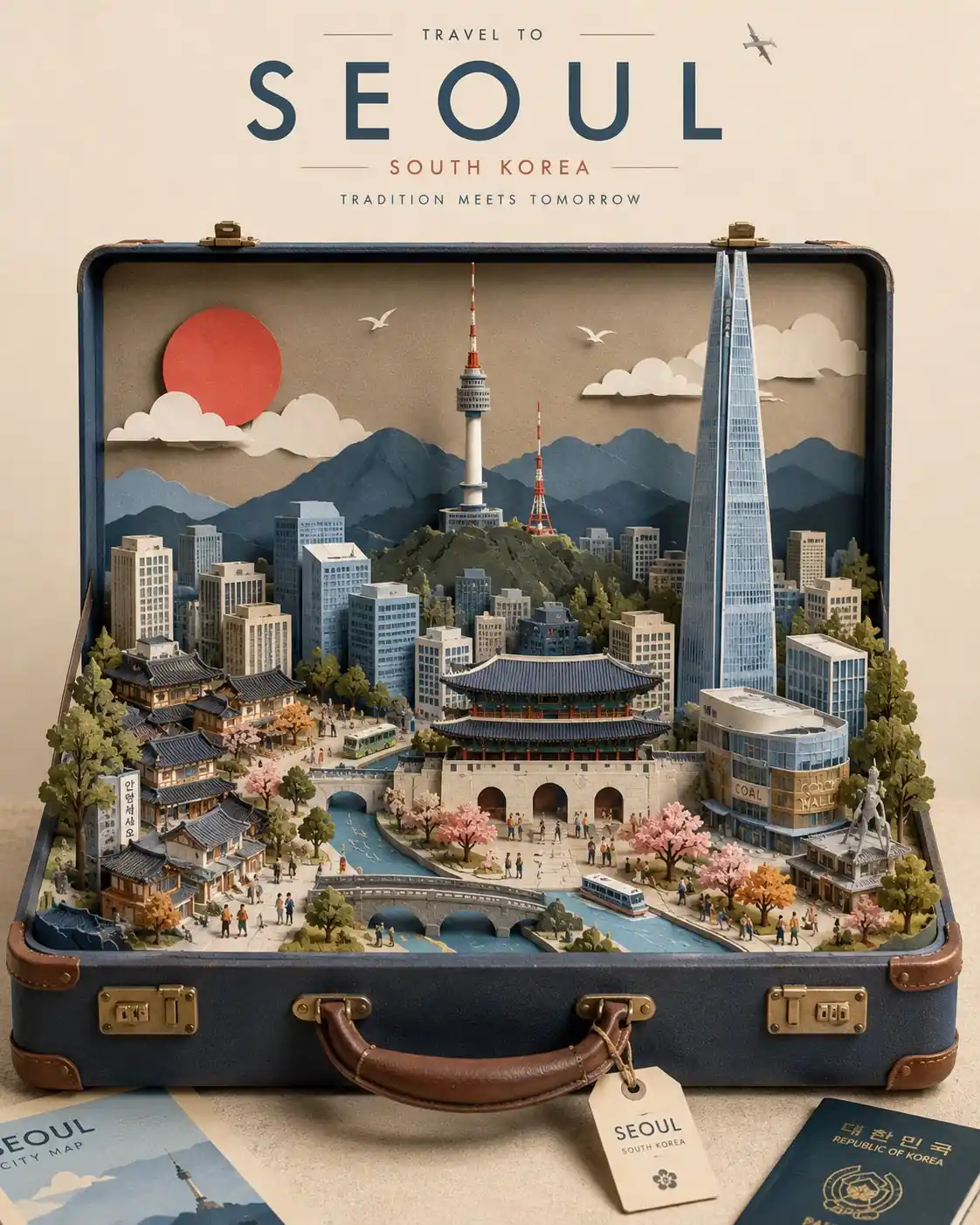
Travel illustrators and destination marketers need a paper cut travel diorama prompt that turns local landmarks into a layered suitcase diorama. This reusable template separates destination research, scene depth, papercraft materials, editorial typography, and output controls so one visual system can support many cities without copying a reference composition.
Image Examples


Strategic Deployment Guide
Model fit: Use an image model that can follow long structured prompts, render layered materials, and attempt short display text. The template is model-agnostic. Generate the art first, then inspect every landmark and letter; image models can produce visually persuasive but geographically false details.
Research before rendering
Build a compact destination sheet before filling the variables. Separate verified landmarks from general mood references, identify the correct city-country label, and choose only features that can remain legible at poster scale. Treat the Seoul, Rome, and Türkiye images as output examples, not factual source material.
Design one coherent miniature world
Choose one visual story rather than listing every attraction. A modern tower, a historic district, a local transit cue, and one geographic anchor usually create stronger identity than a crowded inventory. The suitcase, paper materials, and depth hierarchy stay fixed while the destination data changes.
Paper Cut Travel Diorama Prompt Code
DESTINATION IDENTITY:
Create an original premium travel poster for [DESTINATION IDENTITY]: city [CITY], country [COUNTRY]. Render the title as [CITY NAME DISPLAY] above [COUNTRY DISPLAY]. Do not reproduce an existing poster or reference composition.

LANDMARK AND CULTURAL DATA:
Build a recognizable miniature city using verified [LANDMARK DATA], [TRADITIONAL ARCHITECTURE], [SKYLINE ELEMENTS], [LOCAL TRANSPORT], [NATURAL SCENERY], [VEGETATION], [CULTURAL DETAIL DATA], and [GEOGRAPHIC FEATURES]. Prioritize accurate local identity over generic buildings.

FOREGROUND TO FAR BACKGROUND SCENE LAYOUT:
Use [FOREGROUND DETAILS] for streets, tiny people, trees, vehicles, and tactile objects nearest the viewer. Place [MIDDLE-GROUND LANDMARKS] as the main architectural anchors. Use [BACKGROUND LANDSCAPE] for skyline, coast, hills, or mountains, and [FAR-BACKGROUND SKY] for layered clouds, sun or moon, and atmospheric paper depth. Keep a centered suitcase, a readable city silhouette, and a slightly elevated three-quarter view.

PAPER MATERIALS AND SUITCASE:
Make the entire destination physically constructed from [PAPER MATERIALS], including layered cardstock, precision cutouts, folded components, subtle embossing, paper sculpture, visible fibers, cut edges, delicate imperfections, realistic layer thickness, and miniature contact shadows. The world emerges from an open vintage suitcase made from [SUITCASE MATERIAL] with [SUITCASE FINISH], brass hardware, buckles, handle, seams, and restrained age marks. It must look built inside the case, never pasted onto it.

TRAVEL METAPHOR AND EPHEMERA:
Integrate one destination-specific [TRAVEL METAPHOR] that interacts naturally with the miniature world. Arrange a few [TRAVEL EPHEMERA] around the suitcase with clean spacing and no clutter.

TYPOGRAPHY AND STYLE DIRECTION:
Use [TYPOGRAPHY STYLE] with minimal, spacious, correctly spelled city and country text. Apply [STYLE DIRECTION] and a [PALETTE]. Preserve tactile papercraft, premium editorial art direction, refined negative space, subtle archival fading, cinematic studio lighting, soft ambient shadows, and museum-quality craftsmanship.

CAMERA AND OUTPUT:
Use [CAMERA VIEW], aspect ratio [ASPECT RATIO], output format [OUTPUT FORMAT], and resolution [OUTPUT RESOLUTION]. Deliver crisp architecture, physically believable paper construction, strong foreground-to-background separation, balanced framing, and a collectible vintage-poster finish.

NEGATIVE PROMPT AND CONSTRAINTS:
Avoid copied poster composition, invented landmark mashups, wrong city-country pairing, misspelled display text, generic skyline replacing local identity, plastic or clay surfaces, floating buildings, digitally pasted city, cluttered props, watermark, logo, and border crop. Human-review the landmark identity, geography, transportation, cultural details, typography, and country naming before publication.
Implementation Steps
- Verify city identity: Collect official city names, silhouettes, relative positions, transit cues, and landscape features. Exclude disputed or visually ambiguous elements.
- Assign the depth planes: Put human-scale street details in front, two or three signature landmarks in the middle, and geography or skyline behind them.
- Choose one poster metaphor: Connect a paper airplane, ticket, map fragment, stamp, or luggage tag to a real destination story instead of adding a random decoration.
- Control the paper palette and materials: Name specific card stocks, papers, embossing, folds, and edge treatments so every surface shares the same handcrafted logic.
- Set text and palette: Supply the exact city-country display strings and a restrained destination palette with sufficient contrast against warm ivory.
- Review and regenerate: Zoom into landmarks, signage, flags, transport, hands, and tiny figures. Regenerate structural or factual failures; use post-processing in Photoshop, Illustrator, or Figma only for minor typography and layout repair.
Application Scenarios
- Destination campaigns: Build a coordinated poster series by keeping the suitcase and paper system fixed while changing verified local data.
- Editorial covers: Use the clear vertical hierarchy for travel guides, city features, event promotions, or cultural storytelling.
- Collectible social assets: Adapt the same miniature world to print, carousel covers, and vertical campaign art while preserving the city silhouette.
Why This Prompt Works
The prompt separates factual destination data from fixed visual mechanics. That distinction lets the city change without weakening the suitcase concept. Its foreground-to-far-background plan gives the model a usable spatial hierarchy, while material instructions prevent the result from drifting into glossy CGI. The negative constraints also make geographic and typographic review part of the workflow rather than an afterthought.
Troubleshooting & Optimization
- If the city looks generic: Reduce the landmark list and describe two unmistakable silhouettes, one transit cue, and one geographic anchor more precisely.
- If the suitcase feels pasted on: Restate contact shadows, shared scale, edge occlusion, and the requirement that streets and foundations connect physically to the suitcase interior.
- If the paper looks plastic: Strengthen fibers, matte cardstock, cut edges, fold seams, subtle warping, and realistic layer thickness; remove glossy render language.
- If typography breaks: Generate more negative space, shorten the display copy, and replace imperfect lettering during layout production after verifying the exact names.
FAQ
- Q: What does this paper cut travel diorama prompt create?
A: It creates a vertical editorial poster in which a destination-specific miniature papercraft city appears physically constructed inside an open vintage suitcase. - Q: Can I use the Seoul or Rome landmarks in every version?
A: No. Those are examples only. Replace all destination data and verify it for the selected city and country. - Q: Which fields should I edit first?
A: Start with city, country, landmark data, depth planes, transport, geography, and exact display text. Then tune materials, palette, metaphor, camera, and output. - Q: Will the model spell the destination correctly?
A: Not reliably. Inspect the generated text and use a layout tool for final typography when exact spelling is required.
Use this prompt to generate your version? Share the result in the comments.
Explore more? View Image & Design or Prompt Engineering Guides.
I hope you found this paper cut travel diorama AI prompt helpful.
Follow @bigprompt for more prompts and workflow systems.
Related Big Prompt Hub pages:
Create polished luxury skincare advertisements for premium beauty campaigns
Build folded-paper studio renders with this reusable papercraft prompt
Turn destination photographs into sparse editorial travel abstraction artwork
Run cross-platform username investigations with the complete Sherlock search skill
Build detailed scientific botanical illustration plates with reusable prompt controls
Big Prompt Hub Review
This prompt is strongest as a destination-series system: it offers enough variables to change the city, factual content, depth, materials, typography, metaphor, and output without losing the suitcase identity. The three supplied examples show both the appeal and the risk of the format. Dense miniature worlds can look convincing even when labels or geography are imperfect. Use the prompt for art direction, but require a human fact-check and typography pass before any tourism, editorial, or commercial release.