
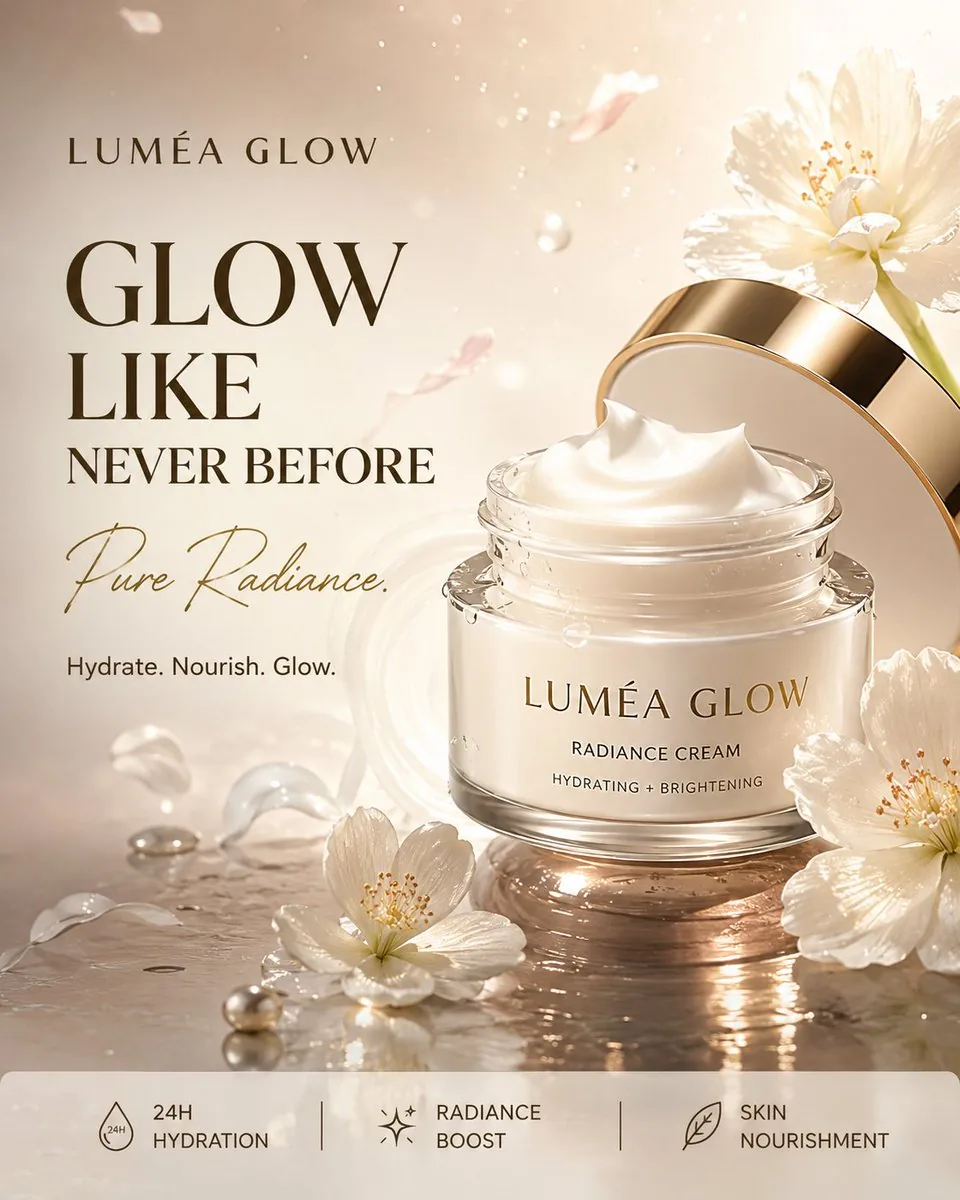
Beauty marketers and cosmetic designers need a skincare advertisement prompt that coordinates product photography, campaign copy, and benefit-led layout in one polished poster. This reusable template separates the brand identity, package design, typography, claims, props, palette, lighting, and delivery format while preserving a premium single-product beauty campaign.
Image Examples

Strategic Deployment Guide
Model fit: Use ChatGPT image generation first when accurate text rendering and detailed prompt adherence matter. Gemini is a useful fallback for testing alternate product staging. Keep the campaign copy, package label, and benefit claims locked across model tests, then compare spelling, jar geometry, and layout balance rather than judging only surface polish.
Best fit
This template fits concept ads, social launch posters, ecommerce campaign previews, presentation mockups, and art-direction boards for a single cream or gel product. It is strongest when the packaging identity and approved claim language are already defined.
Claim and typography control
Replace every highlighted text field with approved copy before generation. AI-generated typography can still drift, so verify every label and claim manually. For regulated or client-facing work, treat the render as a composition draft and rebuild final text in Figma, Photoshop, or Illustrator.
Skincare Advertisement Prompt Code
CAMPAIGN IDENTITY:
Create a premium photorealistic commercial advertisement for a luxury [PRODUCT TYPE] called [BRAND NAME]. Present it as a high-end skincare campaign with a [BACKGROUND MOOD] atmosphere and flawless single-product presentation.

PRODUCT AND MATERIALS:
Place one elegant [CONTAINER DESIGN] prominently in the [PRODUCT POSITION], slightly elevated above a glossy [SURFACE MATERIAL]. Use [CONTAINER MATERIAL] for the jar and a [LID FINISH] lid. Show the open product with a visible [PRODUCT TEXTURE] texture. Preserve physically plausible glass thickness, lid geometry, contact shadows, reflections, and product volume.

PACKAGE LABEL:
Render a minimal, clean label with exact spelling. Show [BRAND NAME] as the brand line, [PRODUCT NAME] as the product line, [LABEL DESCRIPTOR] as the category descriptor, and [LABEL BENEFIT LINE] as the supporting benefit line. Keep all package text aligned, readable, and correctly attached to the jar surface.

SCENE AND PROPS:
Surround the hero product with [ACCENT PROPS], [TEXTURE ACCENTS], and delicate translucent details. Add [ATMOSPHERIC EFFECTS] for freshness and depth. Keep every prop subordinate to the hero jar and leave clean negative space around the typography.

LAYOUT AND TYPOGRAPHY:
Use a vertical [ASPECT RATIO] composition. Place the advertising typography on the [TYPOGRAPHY POSITION]. At the top, set [BRAND NAME] in refined display type. Below it, render the large bold headline as three controlled lines: [HEADLINE LINE 1] / [HEADLINE LINE 2] / [HEADLINE LINE 3]. Add [SCRIPT TAGLINE] in elegant handwritten script, followed by [SUPPORTING LINE] in small clean type.

BENEFIT BAR:
At the bottom, create a clean premium information bar using [BENEFIT BAR LAYOUT]. Divide it into three equal sections labeled [BENEFIT LABEL 1], [BENEFIT LABEL 2], and [BENEFIT LABEL 3]. Use restrained line icons only if they remain crisp and secondary to the text.

STYLE AND LIGHTING:
Use a sophisticated [PALETTE]. Light the set from [LIGHTING DIRECTION] with a soft glowing backlight, realistic reflections, controlled highlights, gentle shadows, and cinematic depth of field. Maintain realistic cream texture, premium beauty photography, and a polished commercial finish.

OUTPUT AND NEGATIVE CONSTRAINTS:
Deliver an ultra-realistic [OUTPUT RESOLUTION] beauty advertisement. Preserve accurate spelling, readable hierarchy, safe margins, and one hero product. Avoid people, hands, watermarks, duplicate jars, extra products, warped packaging, floating lids, melted glass, illegible copy, invented claims, clipped text, and distorted benefit-bar divisions.
Implementation Steps
- Lock approved identity and claims: Fill the brand, product, label, headline, tagline, supporting line, and three benefit fields from an approved copy sheet. Do not let the model invent efficacy language.
- Map the package materials: Describe the jar, lid, visible formula, and reflective surface with physically compatible materials. Separate transparent glass, opaque cream, metallic trim, and wet reflections.
- Build the layout hierarchy: Reserve one side for the hero product and the opposite side for copy. Lock the vertical ratio, safe margins, and bottom information bar before adding atmospheric details.
- Choose a controlled prop family: Use flowers, petals, droplets, cream swirls, or ingredient cues that support the product story. Limit the set so the label and headline remain readable.
- Run a text-first review: Inspect the brand line, package label, headline, tagline, and benefits at full size. Regenerate layout failures; repair final typography with vector text rather than accepting misspellings.
- Finish for production: Use Photoshop masking for minor glass edges and droplets, then rebuild the information bar in Figma or Illustrator when exact alignment, legal copy, or print calibration matters.
Application Scenarios
- Beauty brand launch campaigns: Create a vertical hero poster for Instagram, Pinterest, email, or a retail launch deck.
- Cosmetic ecommerce previews: Give Shopify and marketplace teams a premium concept image before the final product photography session.
- Agency concept presentations: Show clients a complete package, typography, prop, and lighting direction in one campaign mockup.
- Social advertising variants: Keep approved brand copy fixed while testing alternate palettes, props, and hero-product positions for paid ads.
- Retail visual direction: Translate the poster into window-display, counter-card, press-kit, or point-of-sale art direction.
Why This Prompt Works
The template treats the ad as a system rather than a generic product shot. It separates the hero object, physical materials, package label, campaign typography, benefit bar, prop family, palette, lighting, and output constraints. That structure helps an image model preserve hierarchy across a dense vertical composition.
It also repeats the most fragile requirements where they matter. Exact spelling appears in the package and output sections; single-product discipline appears in the identity and negative constraints; realistic material behavior is reinforced through glass thickness, cream texture, contact shadows, and reflections. The result is easier to review and safer to hand off for final typography repair.
Troubleshooting & Optimization
- If the copy is misspelled: Replace the headline with shorter approved lines and append “render each line exactly once with no extra letters.” Rebuild final text in a design tool when legal accuracy is required.
- If the jar geometry breaks: Append “one cylindrical jar with concentric lid, consistent glass thickness, aligned label plane, and grounded contact shadow.”
- If the layout feels crowded: Replace the prop field with two flower clusters and sparse droplets, then add “preserve clean negative space around every text block.”
- If benefits become invented claims: Substitute the three approved benefit labels again and append “do not infer, rewrite, or add performance claims.”
FAQ
- Q: What does this skincare advertisement prompt create?
A: It creates a vertical single-product beauty poster with editable packaging, campaign copy, benefits, props, palette, lighting, and production constraints. - Q: Can I replace the example face cream brand?
A: Yes. Replace every highlighted identity and copy field. The example brand belongs only to the supplied output and is not fixed in the reusable template. - Q: How should I handle skincare claims?
A: Use only approved wording supplied by the brand or compliance team. Verify the package label and benefit bar manually before publication. - Q: Is AI-generated poster text ready for final advertising?
A: Treat it as a strong composition draft. Rebuild critical typography and regulated copy in a design tool for exact spelling, spacing, and legal review.
Use this prompt to generate your version? Share the result in the comments.
Explore more? View Image & Design or Prompt Engineering Guides.
I hope you found this skincare advertisement AI prompt helpful.
Follow @bigprompt for more prompts and workflow systems.
Related Big Prompt Hub pages:
Turn products into tactile folded paper studio renders
Transform travel photos into sparse editorial abstraction artwork
Run cross-platform username investigations with the Sherlock skill
Build detailed scientific botanical illustration study plates
Create layered paper postcard dioramas for travel scenes
Big Prompt Hub Review
This prompt is most valuable as a campaign-layout system: it connects product materials, brand copy, beauty styling, and an information bar without losing the hero jar. Its main limitation is typography reliability. The variable structure makes brand substitution practical, but image-model text still requires close review and often a design-tool finishing pass. Use it for concept development, social mockups, and art direction; use approved photography and rebuilt vector copy for final regulated advertising.