
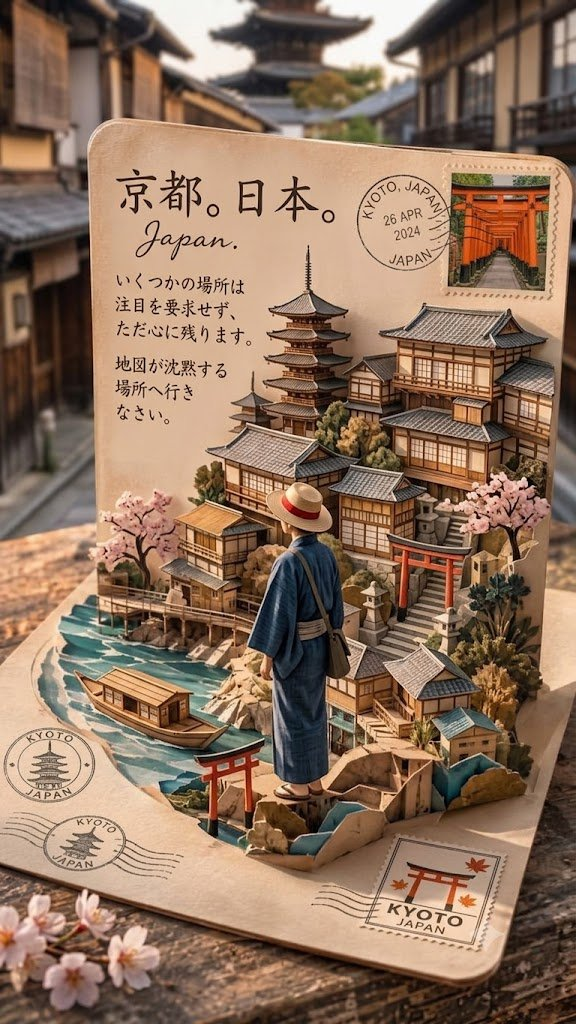
Travel-poster designers and souvenir creators need a pop-up postcard diorama prompt that turns destination landmarks, paper depth, and postcard ephemera into one coherent tabletop scene. The Kyoto image shows one possible preset while the template stays reusable for other locations, seasons, and travelers.
Image Example

Strategic Deployment Guide
Model fit: ChatGPT Image is recommended because it follows coordinated scene variables and layered depth reliably. Keep the physical card structure locked while you swap one complete destination preset. A strong fallback is another image model with long-brief control; if it loses the paper construction or mangles ephemera, shorten optional decoration and repair lettering in a design tool.
pop-up postcard diorama prompt Code
A highly detailed 3D pop-up postcard diorama of [destination/location], featuring [landmark set], [traveler/subject], [season/flora], [route or water feature], [transport element], and [postcard ephemera]. Show it as a premium [visual style] travel postcard on [surface], illuminated by [lighting], with realistic [paper material] texture.

STRUCTURE: Build a physical pop-up card with a stable back panel, layered foreground, middle ground, and background, visible folds, cardstock thickness, cut edges, a protected frame, and balanced safe margins.

IDENTITY CONTROL: Keep [traveler/subject] consistent in scale, silhouette, pose, and placement.

SCENE LOGIC: Arrange [landmark set] around [route or water feature], connect [transport element], frame the route with [season/flora], and place [postcard ephemera] on calm surface areas, never across folds.

LAYOUT CONTROL: Use [aspect ratio], show every postcard edge, keep a clear foreground passage, and reserve negative space for lettering.

MATERIAL AND STYLE: Preserve [paper material] grain and folded shadows, keep [surface] visible beneath the card, and use [visual style] with coherent [lighting].

NEGATIVE PROMPT: flat illustration, collapsed layers, generic skyline, distorted architecture, cluttered text, duplicate subject, cropped edges, plastic CGI, muddy shadows, random landmarks.

OUTPUT REQUIREMENTS: [output format], [aspect ratio], high resolution, crisp paper edges, safe margins, and legible thumbnail composition. Verify landmarks and repair lettering after the scene hierarchy works.
Implementation Steps
- Build one destination preset: Choose the location, landmark set, route or water feature, transport element, traveler, season, and postcard ephemera together so every detail belongs to the same place.
- Preserve the paper logic: Keep layered papercraft depth, the selected tabletop surface, lighting direction, and postcard framing together; set the aspect ratio and safe margins before rendering.
- Review the output manually: Check landmark accuracy, subject scale, transport placement, ephemera legibility, and full postcard edges; use post-render layout repair for lettering and print calibration.
Application Scenarios
- Travel postcard concepts: Generate a destination-led souvenir visual before developing a printed postcard, tourism campaign, or collector card.
- Editorial travel campaigns: Use the layered scene as a hero image for a travel feature, destination landing page, or social post.
- Souvenir and print direction: Hand the visual brief to an illustrator or designer for final typography, stamp cleanup, and print-ready finishing.
Why This Prompt Works
The template works because it ties recognizable destination anchors to a physical paper object. The landmark set establishes place, the traveler and transport element create scale and movement, and the ephemera makes the result read as a postcard instead of a standalone miniature city. The selected surface and lighting then supply the photographic context that makes the paper construction believable.
The Kyoto example uses a pagoda, traditional houses, river boat, cherry blossoms, stamps, and calligraphy as one coordinated preset. Those details are replaceable; the layered construction, protected postcard frame, safe margins, and clear depth hierarchy stay fixed. Human review is still needed for lettering, landmark accuracy, and small paper edges.
Troubleshooting & Optimization
- If it looks flat: append “visible cardstock layers, folded planes, foreground/middle-ground/background depth, photographed on a rustic wooden table.”
- If the destination feels generic: replace vague location wording with a precise landmark set, a route or water feature, one local transport element, and season-specific flora.
- If text is unreliable: request minimal, uncluttered postcard ephemera in a calm panel, then correct the final lettering manually.
pop-up postcard diorama prompt FAQ
- Q: What is a pop-up postcard diorama prompt?
A: It is a reusable image prompt for a destination scene that looks like a layered paper postcard photographed as a physical tabletop object. - Q: How does the Kyoto preset map to the variables?
A: Kyoto and Japan fill the destination field; the pagoda, houses, traveler, river boat, cherry blossoms, stamps, calligraphy, golden light, wooden table, and vertical format are example values rather than fixed template content. - Q: Can the prompt work for another city?
A: Yes. Replace Kyoto-specific landmarks with a new destination set, but preserve the layered pop-up construction, tabletop context, and postcard framing.
Share your finished destination variation in the comments, especially if you adapt the paper structure to another city or season.
Explore more? View Image & Design or Prompt Engineering Guides.
This pop-up postcard diorama prompt is best treated as a visual starting point; verify landmarks and repair small text before commercial or printed use.
Follow @bigprompt for more prompts and workflow systems.
Related visual prompt reading:
Watercolor Architectural Travel Poster Prompt
Scrapbook Travel Poster Prompt
Modern House Miniature Infographic Prompt
Big Prompt Hub Review
This is a strong travel-visual Prompt because destination landmarks, paper construction, traveler scale, and postcard ephemera reinforce one another without locking the asset to a single city. The Kyoto image demonstrates one cohesive preset. Its main limitation is small text and landmark precision: approve the composition first, then correct lettering and factual details for final use.